

Filling a prescription can become another source of uncertainty after an accident. Many patients worry about how they will pay for accident-related medications, especially if their claim is still being sorted out.
While some personal injury pharmacies may offer written billing arrangements for eligible prescriptions, these options are not automatic and can vary depending on the patient’s circumstances, pharmacy requirements, and the terms of any applicable agreement.
Clear information about payment responsibilities, prescription coordination, and available pharmacy services can help reduce uncertainty during recovery.
Key takeaway
- "No upfront cost" may refer to a written billing arrangement for eligible prescriptions, but the terms and payment responsibilities should always be confirmed.
- Billing options vary. Depending on your circumstances, you may use health insurance, pay directly, or discuss other available billing options.
- Ask questions before filling your prescription. Confirm eligibility, payment timing, and whether the terms are provided in writing.
- Same-day or next-day delivery may be available for eligible prescriptions within eligible delivery areas, subject to pharmacy requirements and availability.
- EZlinkMeds Pharmacy can assist with prescription transfers, refill support, billing options, and delivery availability for eligible prescriptions.
What “No Upfront Cost” Should Mean Before You Fill a Prescription
The phrase “no upfront cost” does not always have the same meaning. Depending on the pharmacy and the circumstances, it may refer to a written billing arrangement for eligible prescriptions that allows payment to be handled according to agreed terms rather than requiring payment when the prescription is dispensed.
Because these arrangements vary, patients should not assume that “no upfront cost” applies automatically or in every situation.
Before filling an accident-related prescription, ask the pharmacy to explain exactly how the billing process works and review any written agreement carefully.
Patients should confirm when payment may be due, who is responsible for the prescription charges, which prescriptions may be eligible, and whether any specific conditions or requirements apply.
It is also important to ask what happens if the personal injury claim changes or does not resolve as expected. The answers depend on the terms of the written agreement and the patient’s individual circumstances.
If anything is unclear, the pharmacy team can explain the available billing options before the prescription is filled.
Questions to Ask Before Using a Deferred-Billing Pharmacy Arrangement
Before choosing a pharmacy that offers a deferred-billing arrangement, it is helpful to ask a few questions so you understand how the process works and what to expect. The answers may vary depending on the pharmacy, your prescription, and any written agreement.
➤ Am I eligible?
Ask whether your prescription and circumstances qualify for any available deferred-billing arrangement and what information is needed to determine eligibility.
➤ Is this prescription covered by the arrangement?
Confirm whether the arrangement applies to all of your accident-related prescriptions or only certain eligible medications.
➤ Who is responsible for payment?
Request a clear explanation of your payment responsibilities, including how charges are handled under the written agreement.
➤ When may payment be due?
Ask when payment obligations may arise and what happens if your circumstances or claim change before the matter is resolved.
➤ What records may be shared?
Find out what prescription or billing information may be shared, who may receive it, and how your written authorization or another applicable legal basis is obtained before any records are released.
➤ Is delivery available?
Ask whether delivery is offered for your prescription and location. Same-day or next-day delivery may be available for eligible prescriptions within eligible delivery areas, subject to prescription verification, medication availability, order timing, and applicable pharmacy requirements.
When Accident Patients May Need Prescription Billing Support
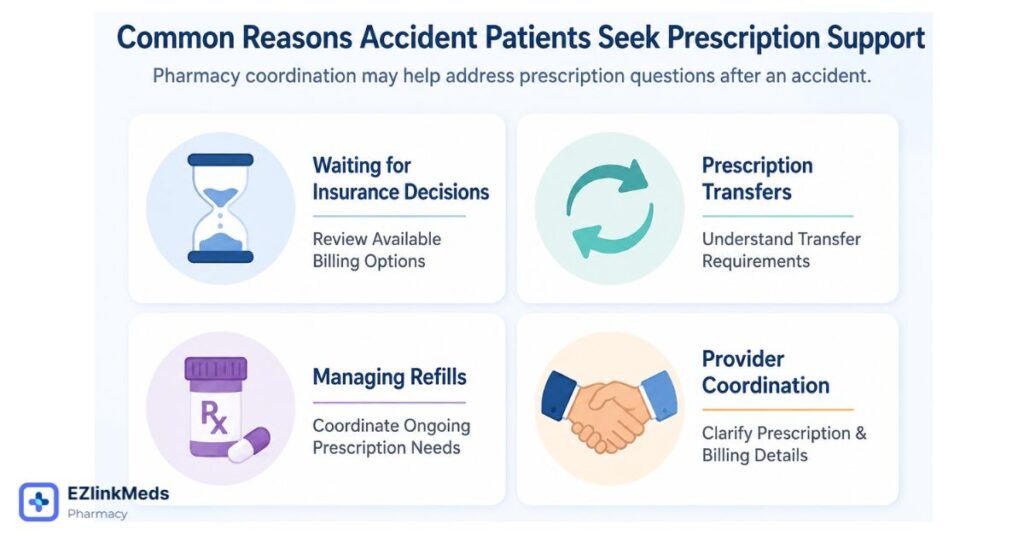
Prescription billing support may be helpful in a variety of situations after an accident. While every patient’s circumstances are different, the following scenarios are common reasons to speak with the pharmacy about available billing and prescription coordination options.
Waiting for Insurance Decisions
Insurance questions or claim reviews can sometimes delay decisions about how accident-related expenses will be handled.
During this time, patients may wish to discuss available pharmacy billing options for eligible prescriptions rather than making assumptions about payment.
Questions About Transferring a Prescription
If a prescription has already been sent to another pharmacy, patients may be unsure whether it can be transferred. The pharmacy team can explain whether a transfer is possible and what information or prescriber authorization may be required.
Managing Refills After Urgent Care or Specialist Visits
Follow-up care often involves more than one healthcare provider, and patients may need refills after visiting an urgent care clinic, orthopedic specialist, or another licensed prescriber.
The pharmacy can explain the refill process, including any authorization, prescription validity, or pharmacy requirements that apply before a refill can be dispensed.
Coordinating With Authorized Providers or Referral Partners
In some cases, prescription coordination may involve communication with authorized healthcare providers or referral partners to help clarify prescription information or billing details. Any sharing of patient or prescription information should occur only with the patient’s written authorization or another applicable legal basis, in accordance with privacy requirements.
How EZlinkMeds Reviews Prescription Support Requests
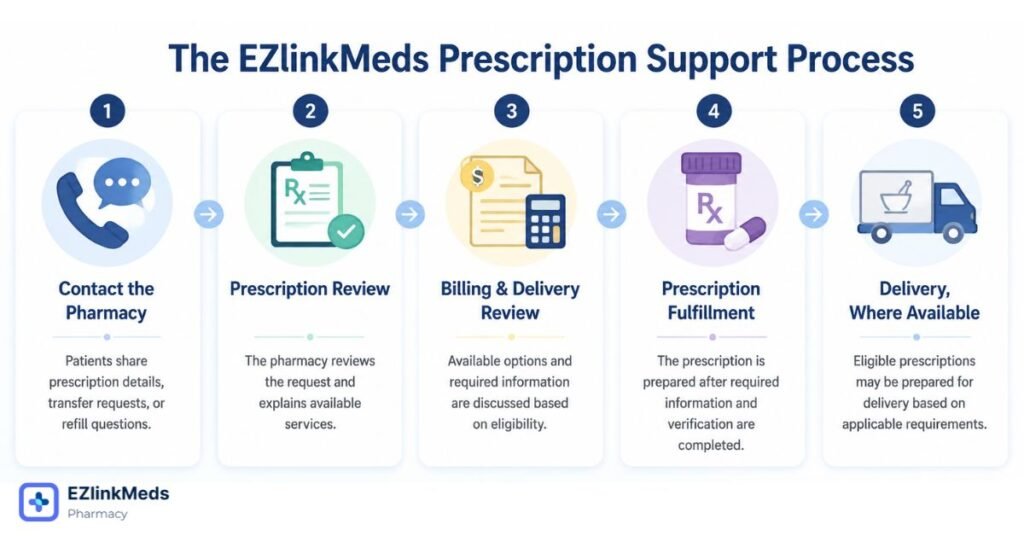
Every accident-related prescription is different, so the first step is reviewing the patient’s individual circumstances rather than assuming the same process applies to everyone.
EZlinkMeds works with patients to understand their prescription needs, answer questions about available pharmacy services, and explain the next steps based on the information provided.
Step 1: Contact the Pharmacy
Patients can contact EZlinkMeds with a new prescription, an existing prescription they would like to transfer, or questions about refills. The pharmacy gathers the information needed to begin reviewing the request.
Step 2: Prescription Review
After reviewing the prescription, the pharmacy explains the services that may be available, such as prescription transfers, refill assistance, delivery options, or available billing arrangements for eligible prescriptions.
Any available options depend on the patient’s circumstances and applicable pharmacy requirements.
Step 3: Review of Available Billing and Delivery Options
If additional information is needed before the prescription can be processed, the pharmacy explains what documents or authorizations may be required. This helps ensure the request can be handled in accordance with applicable pharmacy and privacy requirements.
Step 4: Prescription Fulfillment
Once all necessary information has been received and the prescription meets applicable pharmacy requirements, the pharmacy prepares it for dispensing. Medication availability, prescription verification, and prescriber authorization may all affect processing.
Step 5: Delivery, Where Available
If the patient requests delivery and it is available, the pharmacy discusses the available delivery options. Same-day or next-day delivery may be available for eligible prescriptions within eligible delivery areas, subject to prescription verification, medication availability, order timing, delivery conditions, and applicable pharmacy requirements.
What Patients Should Know About Privacy and Record Sharing
Protecting your personal and prescription information is an important part of the pharmacy process. If your prescription involves communication with healthcare providers or other authorized parties, it helps to understand how your information may be used and shared.
- Your information is protected. Pharmacies must handle prescription and personal information in accordance with applicable privacy laws and pharmacy confidentiality requirements.
- Written authorization may be required. If prescription or billing records need to be shared with an attorney, healthcare provider, or another third party, the pharmacy may require your written authorization unless another applicable legal basis permits the disclosure.
- Pharmacy records help keep information organized. Prescription history, fill dates, refill records, and itemized billing statements can help you review your medications and pharmacy-related charges.
- Ask questions if you are unsure. The pharmacy team can explain its privacy practices, any required authorization forms, and how your prescription information may be shared.
Red Flags to Clarify Before Signing Any Billing Agreement
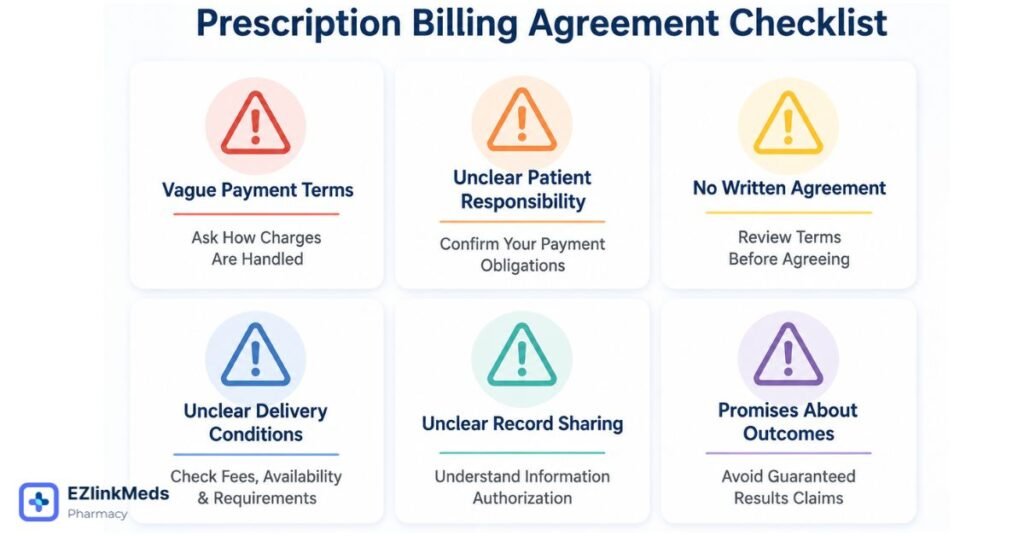
Before agreeing to any prescription billing arrangement, take time to review the terms carefully and ask questions if anything is unclear. A written agreement should clearly explain how the arrangement works so you understand your responsibilities before the prescription is filled.
– Vague payment terms. Ask when payment may be due, how charges are handled, and whether any conditions could affect the billing arrangement.
– Unclear patient responsibility. Confirm whether you remain responsible for prescription charges and under what circumstances payment obligations may change.
– No written agreement. If a billing arrangement is offered, request the terms in writing and review them before agreeing to proceed.
– Unclear delivery fees or conditions. Ask whether any delivery charges apply, if delivery is available for your location, and whether there are any timing or eligibility requirements.
– Unclear record-sharing authorization. Make sure you understand what prescription or billing information may be shared, who may receive it, and whether your written authorization is required.
– Promises about settlements or legal outcomes. Be cautious of statements suggesting a pharmacy can guarantee settlement results, affect the value of your claim, or eliminate your financial responsibilities. If you have legal questions, discuss them with your attorney before relying on those statements.
Conclusion
If you need assistance with an accident-related prescription, contacting EZlinkMeds early can help clarify the options available for your situation.
Whether you have a new prescription, need to transfer an existing one, or have questions about a refill, the pharmacy team can explain the information needed to begin the process.
During your conversation, you may be asked for your prescription details and the name of your licensed prescriber so the pharmacy can review your request. Based on that information, the team can discuss available pharmacy services, explain any billing options that may apply to eligible prescriptions, and answer questions about the next steps.
If you are interested in having your prescription delivered, ask whether delivery is available for your medication and location. Same-day or next-day delivery may be available for eligible prescriptions within eligible delivery areas.
If you are unsure where to begin, contact EZlinkMeds Pharmacy to discuss your prescription needs, ask about available pharmacy services, and determine the next appropriate step based on your individual circumstances.
Sources:
California State Board of Pharmacy – California Pharmacy Law Book
U.S. Department of Health & Human Services – HIPAA Privacy Rule