



Successful personal injury cases rely on more than legal representation alone. They also depend on effective coordination between attorneys, healthcare providers, case managers, and other professionals involved in a client’s treatment.
When prescription-related communication or documentation becomes disorganized, it can create unnecessary administrative work and slow important case tasks.
A specialized personal injury pharmacy can serve as a prescription-support partner to the legal team by assisting with prescription management, organized documentation, and authorized communication throughout treatment. For law firms across Southern California, building a strong pharmacy partnership can help streamline case management while supporting clients from the start of treatment through case resolution.
Organized pharmacy documentation does not determine liability, damages, or settlement value. It may, however, help legal teams review documented prescription activity and pharmacy charges more efficiently when preparing case materials.
Key takeaway
- A strong attorney–pharmacy partnership helps simplify prescription-related communication, organized documentation, and ongoing case coordination throughout a client's treatment.
- Specialized personal injury pharmacies may support attorneys, case managers, healthcare providers, and patients by reviewing prescriptions, maintaining organized records, and responding to prescription-related questions.
- Consistent collaboration between legal teams and pharmacies can help reduce administrative burdens while keeping prescription information current and readily accessible.
- EZlinkMeds may assist personal injury law firms, healthcare providers, case managers, and injured patients across Southern California with prescription review, pharmacist consultation, organized documentation, and delivery discussions where available.
Building an Attorney–Pharmacy Partnership
A successful attorney–pharmacy partnership is built on clear communication, organized processes, and a shared commitment to supporting clients throughout treatment.
By working together, law firms and specialized pharmacies can help simplify prescription-related coordination, reduce administrative burdens, and maintain consistent support from the beginning of a case through its conclusion.
An effective partnership extends beyond filling prescriptions. It involves ongoing collaboration between attorneys, case managers, healthcare providers, and pharmacy teams to keep prescription-related information organized and accessible when needed. With clearly defined communication channels and streamlined processes, legal teams can spend less time managing pharmacy-related administrative tasks and more time focusing on client advocacy and case preparation.
As treatment progresses, a specialized pharmacy can continue supporting the partnership by responding to prescription-related questions, maintaining organized documentation, and communicating with authorized parties as appropriate.
This collaborative approach helps create a more efficient workflow for everyone involved while supporting continuity throughout the client’s care.
For a broader overview of prescription coordination, medication management, and pharmacy operations within personal injury litigation, see The Complete Guide to Med-Legal Prescription Delivery: Optimizing Pharmacy Operations for Attorneys and Doctors.
Where Lien-Based Pharmacy Services Fit Into the Partnership
In a personal injury matter, a specialized pharmacy may offer a written billing arrangement for eligible prescriptions. Under such an arrangement, payment may be deferred according to agreed terms rather than collected when the medication is dispensed.
These arrangements are contractual and should not be treated as automatic or identical in every case. A contractual pharmacy billing arrangement should not be assumed to have the same statutory status, notice requirements, enforcement rules, or payment protections as a hospital lien governed by California Civil Code §§ 3045.1–3045.6. The law firm, patient, and pharmacy should confirm who must sign, which prescriptions qualify, when payment may become due, whether the patient remains responsible if no recovery is obtained, and how authorized billing information will be handled during the case.
For legal teams, the value of this model is not simply delayed payment. It is the ability to coordinate eligible injury-related prescriptions, pharmacy communication, and billing documentation through a more organized process while the matter remains active.
How a Specialized Pharmacy Supports Every Stage of a Personal Injury Case
A specialized personal injury pharmacy can provide support at every stage of a case, helping attorneys, case managers, healthcare providers, and patients stay connected throughout the treatment process. Here’s how that support may evolve from client intake through case resolution.
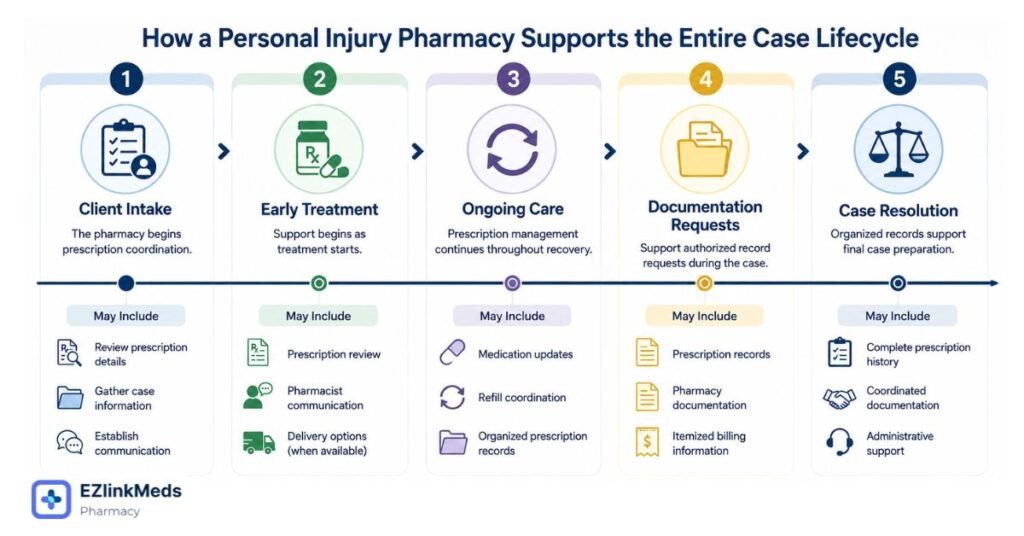
Client Intake
The partnership often begins when the pharmacy receives a new prescription or referral. During this stage, the pharmacy may review prescription details, gather the necessary information, and establish communication with authorized parties.
Creating an organized foundation early in the process can help support prescription-related coordination throughout the case.
Early Treatment
During the first phase of treatment, patients may receive medications from emergency physicians, orthopedic specialists, pain management providers, or other healthcare professionals.
A specialized pharmacy may review prescriptions, answer medication-related questions, communicate with licensed prescribers when clarification is needed, and discuss available delivery options for eligible prescriptions.
Ongoing Care
As treatment continues, additional medications, prescription changes, and refill activity may occur. A specialized pharmacy can help maintain organized records of the prescriptions it receives and dispenses while continuing to support patients, case managers, and authorized healthcare providers throughout the course of treatment.
Documentation Requests
Throughout an active case, attorneys and case managers may need updated pharmacy records for administrative purposes. When appropriate patient authorization or another applicable legal basis exists, the pharmacy may provide organized records of prescriptions handled through that pharmacy, available itemized pharmacy information, and other requested documentation.
Case Resolution Preparation
As treatment nears completion and the case moves toward resolution, having organized pharmacy documentation can simplify the review of prescription activity accumulated over the course of care. Maintaining consistent records from the first prescription through the latest pharmacy updates helps attorneys and case managers access the documentation they need while supporting efficient case preparation.
Responsibilities Shared Between the Law Firm and the Pharmacy
An effective attorney–pharmacy partnership is built on shared responsibilities. While each plays a different role, both contribute to keeping prescription-related information organized, supporting client care, and maintaining efficient communication throughout the life of a personal injury case.
Common Areas of Attorney–Pharmacy Coordination |
|
|---|---|
| Law Firm or Case Team | Pharmacy |
| Helps the Client Understand the Law Firm’s Case-Related Process | Reviews Prescriptions Received by the Pharmacy |
| Coordinates Any Authorizations or Documentation Required for Third-Party Record Requests | Maintains Records of Prescriptions Processed and Dispensed by the Pharmacy |
| Requests Pharmacy Records for the Case File When Appropriate | Responds to Authorized Record Requests in Accordance With Privacy Requirements |
| Keeps Its Own Case File Current as Treatment Information Is Received | Provides Available Itemized Pharmacy Statements When Requested and Authorized |
| Directs Legal and Settlement Questions to the Appropriate Legal Professional | Responds to Medication and Dispensing Questions Within the Pharmacist’s Professional Scope |
Keeping Client Treatment Moving Without Administrative Delays
Administrative delays can interrupt communication and create additional work for both legal teams and healthcare providers. The following practices may help keep prescription-related processes organized throughout treatment:
- Monitor Missing Prescriptions: Follow up promptly if an expected prescription has not been received or processed.
- Address Documentation Questions Early: Resolve questions about pharmacy records or requested documents before they delay case administration.
- Maintain Provider Communication: Keep communication open with licensed prescribers when prescription clarification is needed.
- Keep Records Organized: Maintain current prescription histories, pharmacy statements, and related documentation in one place.
- Respond to Requests Promptly: Timely responses to prescription-related inquiries can help keep treatment and case management moving efficiently.
Supporting Better Coordination Between Attorneys, Providers, and Patients
Effective case management often depends on timely communication between everyone involved in a client’s care. A specialized personal injury pharmacy can help facilitate prescription-related communication, making it easier to keep information organized throughout the treatment process.
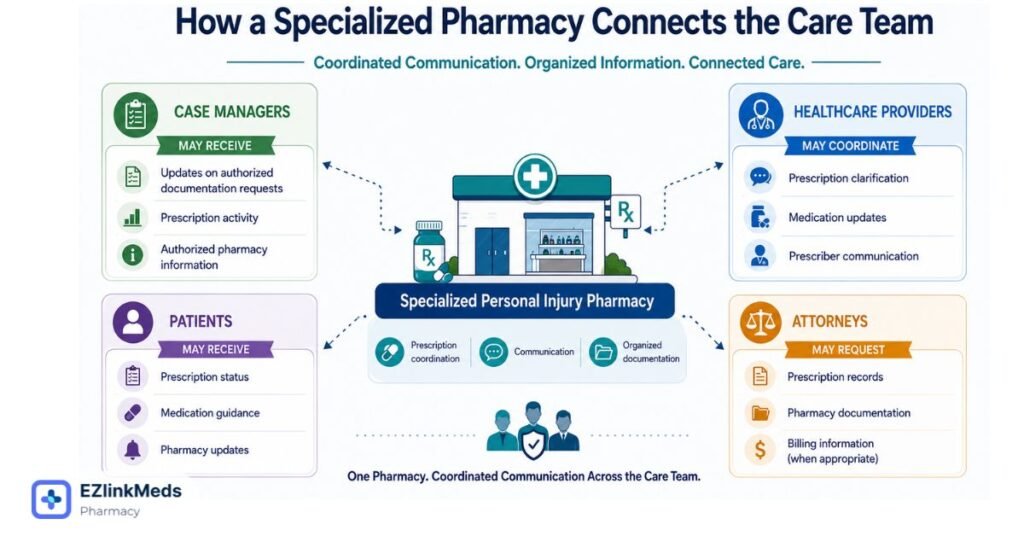
Communication With Case Managers
Case managers often coordinate prescription-related information while overseeing treatment progress.
A specialized pharmacy may help by providing updates on authorized documentation requests, prescription activity, and other pharmacy-related information needed for case administration.
Communication With Healthcare Providers
When prescription clarification is needed, the pharmacy may communicate with licensed prescribers to help ensure prescription information is complete and accurately reflects the provider’s instructions.
Communication With Patients
Keeping patients informed about prescription-related matters can help reduce confusion during treatment. Pharmacy staff may communicate with patients regarding prescription status, medication instructions, or other pharmacy-related updates, helping them understand the next steps in the prescription process.
Prescription-Related Questions
Throughout an active case, attorneys, case managers, healthcare providers, and patients may have questions about prescription records, medication history, or pharmacy documentation.
A specialized pharmacy can serve as a centralized point of contact for prescription-related inquiries, helping streamline communication while supporting accurate and organized record management.
Questions a Law Firm Should Resolve Before Referring a Client
Before referring a client or relying on a specialized pharmacy arrangement, the law firm should confirm how the pharmacy handles eligibility, billing, documentation, communication, and service availability. Important questions include:
- Which patients and prescriptions may qualify for the available arrangement?
- Is a written billing agreement required?
- Who must sign or authorize the arrangement?
- Who may remain responsible for payment if the personal injury matter produces no recovery?
- How can the law firm request itemized pharmacy statements?
- What patient authorization or other legal basis is required before records may be shared?
- Can the pharmacy process valid prescriptions from multiple licensed prescribers?
- Which delivery areas and estimated timeframes are currently available?
- Who will serve as the law firm’s contact for prescription and documentation questions?
How EZlinkMeds Supports Personal Injury Law Firms Across Southern California
EZlinkMeds supports personal injury law firms, healthcare providers, case managers, and injured patients by helping simplify prescription-related communication throughout treatment.
The pharmacy may assist with prescription review, maintain organized documentation, provide pharmacist consultations, and respond to prescription-related questions as treatment progresses. For eligible prescriptions and locations, same-day delivery options may also be available.
EZlinkMeds may provide additional communication and prescription-support services based on the needs of the individual matter and the services currently available. Law firms and healthcare providers should confirm language support, workers’ compensation assistance, and other case-specific capabilities directly with the pharmacy.
EZlinkMeds may assist attorneys, healthcare providers, case managers, and injured patients throughout Los Angeles, Glendale, Burbank, Pasadena, Long Beach, Santa Clarita, Thousand Oaks, Westlake Village, Oxnard, Ventura, and nearby Southern California communities, providing prescription-related support tailored to the needs of active injury cases.
Conclusion
Building a reliable attorney–pharmacy partnership can help create more efficient prescription coordination, clearer communication, and organized documentation throughout the life of a personal injury case.
Working together allows legal teams and healthcare providers to focus on supporting clients while keeping prescription-related information readily accessible.
EZlinkMeds is available to support attorneys, case managers, and healthcare providers throughout Southern California with prescription coordination, organized documentation, and pharmacy-related assistance for active personal injury cases.
Contact EZlinkMeds to discuss your firm’s prescription-referral process, authorized documentation requests, available billing arrangements, delivery coverage, and the pharmacy services currently available for personal injury matters.