


Clear pharmacy documentation plays an important role in personal injury case management. Prescription records, billing statements, and medication histories often become part of the documentation attorneys and case managers review when preparing demand packages and organizing special damages.
When pharmacy information is incomplete or scattered across multiple sources, assembling a complete case file can become more time-consuming. A structured pharmacy documentation process helps organize prescription records throughout treatment, making it easier for legal teams across Southern California to manage case-related information efficiently.
When pharmacy information is incomplete or scattered across multiple sources, assembling a complete case file can become more time-consuming. A structured pharmacy documentation process helps organize prescription records throughout treatment, making it easier for legal teams across Southern California to manage case-related information efficiently.Where Pharmacy Documentation Fits Within a Personal Injury Case
Pharmacy documentation plays an important role in organizing prescription-related information throughout a personal injury case.
As treatment progresses, prescription records become part of the broader case file used to review medical care, assemble supporting documentation, and prepare materials for settlement discussions.
A typical documentation timeline often follows this progression:
Prescription Issued
↓
Medication Dispensed by the Pharmacy
↓
Prescription Information Added to Medical and Pharmacy Records
↓
Documentation Reviewed During Demand Package Preparation
↓
Pharmacy Records Included During Settlement Review, as Appropriate
Effective case documentation begins with a structured prescription workflow. For a broader overview of how prescription coordination, pharmacy documentation, and medication management fit into comprehensive med-legal prescription delivery workflows, see our complete guide for attorneys, healthcare providers, and injured patients.
Key takeaway
- Organized pharmacy documentation can help attorneys and case managers review prescription records more efficiently throughout a personal injury case.
- Pharmacy records may expand over time as medications are prescribed, updated, refilled, and documented during treatment.
- Itemized pharmacy documentation can provide a clearer record of prescription activity than standard retail receipts.
- Keeping prescription histories and pharmacy statements current may simplify demand package preparation and administrative record requests.
- EZlinkMeds supports attorneys, healthcare providers, case managers, and injured patients across Southern California with organized prescription documentation and prescription-related assistance.
Documents That May Be Added to the Case File Over Time
As a personal injury case progresses, additional prescription-related documents may be added to the case file. The following records commonly contribute to a more complete pharmacy history throughout the course of treatment.
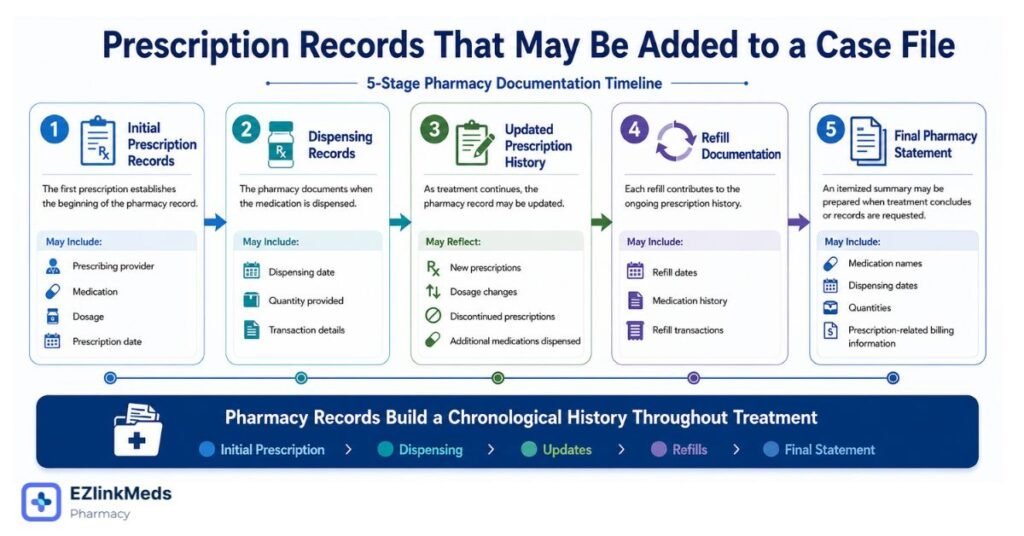
Initial Prescription Records
The first prescription issued after an injury often establishes the starting point of the pharmacy record. These records may identify the prescribing provider, medication, dosage, and the date the prescription was issued.
Dispensing Records
Once a prescription is filled, the pharmacy generates dispensing records documenting when the medication was provided, the quantity dispensed, and other transaction details.
These records help establish a chronological history of prescription activity as treatment continues.
Updated Prescription and Dispensing History
As treatment progresses, the pharmacy’s records may reflect new prescriptions, discontinued prescriptions communicated to the pharmacy, dosage changes, and medications dispensed by that pharmacy. Keeping these records current can help provide a clearer history of the prescription activity handled through the pharmacy.
Refill Documentation
If a medication is refilled, the pharmacy typically records each refill transaction, creating an ongoing history of prescription activity. These records may be reviewed alongside the broader pharmacy documentation when requested.
Final Pharmacy Statement
At the conclusion of treatment or when pharmacy records are requested, an itemized pharmacy statement may summarize the prescription activity associated with the case.
Depending on the pharmacy’s documentation practices, this statement may include medication names, dispensing dates, quantities, and other prescription-related billing information.
How Pharmacy Billing Records Change Throughout Treatment
Pharmacy billing documentation is created over time rather than all at once. As prescriptions and treatment plans change, additional information may be added to the billing record. Below are some of the common updates that may appear throughout a patient’s recovery.
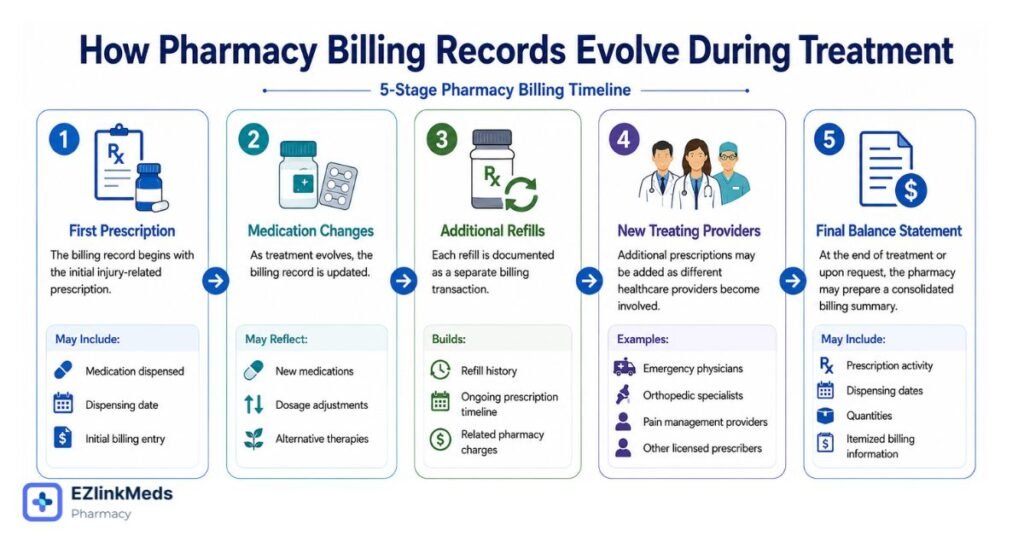
First Prescription
The billing record typically begins with the first injury-related prescription. This initial entry may include the medication dispensed, the dispensing date, and the associated pharmacy billing information.
Medication Changes
Treatment plans often evolve during recovery. When a healthcare provider changes a medication, adjusts the dosage, or prescribes an alternative therapy, these updates may be reflected in the pharmacy billing record. Keeping these changes documented helps ensure the record accurately reflects the patient’s ongoing treatment.
Additional Refills
When medications are refilled, each refill is recorded as a separate transaction. Over time, these entries create a chronological record of ongoing prescription activity and related pharmacy charges.
New Treating Providers
As patients transition between emergency physicians, orthopedic specialists, pain management providers, or other healthcare professionals, additional prescriptions may be added to the pharmacy record.
Maintaining these billing entries together can provide a more organized record of the prescriptions dispensed by that pharmacy during treatment.
Final Balance Statement
When treatment concludes or pharmacy documentation is requested, the pharmacy may prepare a final itemized balance statement.
Depending on the pharmacy’s documentation practices, this statement may summarize prescription activity, dispensing dates, quantities, and related billing information accumulated throughout the patient’s course of care, providing a consolidated record for administrative review.
Building a Complete Pharmacy Timeline
A chronological pharmacy timeline can make it easier for attorneys and case managers to review prescription activity throughout a personal injury case. Rather than relying on individual documents, a structured timeline helps organize prescription events from the beginning of treatment through the final pharmacy records.
- First Fill: The timeline begins when the first injury-related prescription is dispensed, establishing the initial pharmacy record.
- Prescription Updates: New prescriptions, dosage changes, and discontinuation instructions received and processed by the pharmacy may be added as treatment progresses.
- Additional Refills: Each refill creates another documented entry, reflecting continued prescription activity throughout recovery.
- Prescription Changes: New or revised prescriptions received and processed by the pharmacy are incorporated to maintain an accurate record of the prescription activity handled through that pharmacy.
- Final Documentation: The timeline concludes with the most current pharmacy records, including the final itemized documentation available at the time records are requested or treatment ends.
Common Documentation Questions Before Preparing a Demand Package
Before assembling a demand package, reviewing pharmacy documentation can help identify any missing or outdated records. The following checklist may help attorneys and case managers confirm that prescription-related documentation is complete and organized.
– Are all injury-related prescriptions accounted for?
– Have refill records been obtained and reviewed?
– Are prescription and dispensing dates consistent across the available records?
– Are the most recent itemized pharmacy billing statements included?
– Are pharmacy records complete and ready for administrative review?
Organized pharmacy documentation is only one part of an efficient attorney-pharmacy relationship. Learn how lien-based pharmacy partnerships can support communication, client service, and case coordination throughout a personal injury matter.
Retail Receipts vs. Itemized Pharmacy Documentation
Retail pharmacy receipts and itemized pharmacy documentation serve different purposes. While a receipt generally confirms a transaction, an itemized pharmacy ledger may provide additional prescription details that can help legal teams review pharmacy records more efficiently throughout a personal injury case.
In this article, an “itemized pharmacy ledger” means a pharmacy-generated record that organizes the prescription and billing information maintained by that pharmacy. Its contents may vary by pharmacy, account arrangement, and request type, and the term does not refer to a standardized California court form or guarantee that a document will be accepted for a particular legal purpose.
Retail Pharmacy Receipt vs. Specialized Pharmacy Ledger |
||
|---|---|---|
| Documentation Element | Standard Retail Pharmacy Records | Specialized Pharmacy Documentation |
| Medication Information | The pharmacy maintains prescription and dispensing information for medications handled through its system. | The same information may be organized into a format developed for personal injury account administration. |
| Dispensing History | Records may be retrieved by transaction, patient profile, location, or pharmacy organization. | Records for prescriptions handled through the pharmacy may be consolidated through one point of contact. |
| Refill Records | Refill transactions are maintained by the pharmacy and may require a formal records request. | Refill activity may be presented as part of a consolidated dispensing history. |
| Billing Details | Consumer receipts or other billing records may be available, depending on the pharmacy and request type. | Itemized billing information may be organized for the pharmacy’s personal injury accounts. |
| Prescription Timeline | A timeline may need to be assembled from the records supplied. | The pharmacy may provide records in chronological order to assist administrative review. |
| Record Requests | Procedures may vary by pharmacy organization or location. | Authorized requests may be coordinated through a centralized contact, subject to privacy requirements. |
Keeping Pharmacy Documentation Current During Active Treatment
Pharmacy documentation should continue to reflect a patient’s treatment as it changes over time. As new prescriptions are issued, medications are adjusted, or treatment plans evolve, maintaining current records can help attorneys and case managers review accurate prescription information throughout the course of a personal injury case.
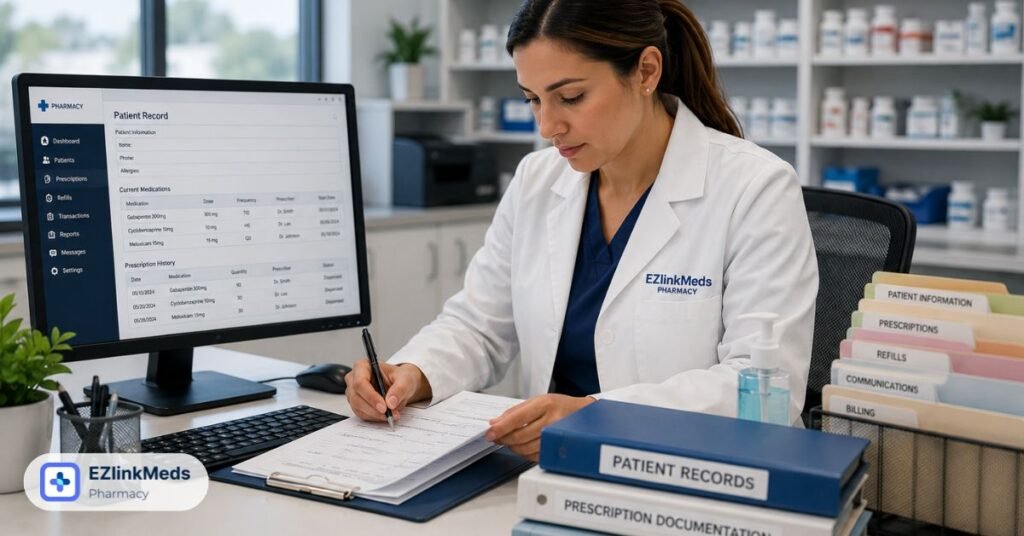
- New Medications: Add newly prescribed injury-related medications to the pharmacy record as they are dispensed to maintain an accurate treatment history.
- Discontinued Prescriptions: When a prescriber communicates that a prescription has been discontinued or replaced, the available pharmacy documentation should be updated accordingly. Pharmacy records may not independently reflect every change made outside the pharmacy.
- Updated Statements: Request the most recent itemized pharmacy statements periodically to ensure the available documentation includes the latest prescription activity.
- Revised Prescription History: Review the available pharmacy records regularly to confirm they reflect processed prescription changes, refill activity, and prescriptions received from the patient’s treating providers.
- Ongoing Treatment: Continue updating pharmacy documentation throughout treatment until the most current records are available for administrative review or case preparation.
How EZlinkMeds Supports Documentation Throughout a Case
Throughout a personal injury case, prescription records often continue to evolve as treatment progresses. EZlinkMeds helps support this process by maintaining organized pharmacy documentation that can be reviewed as new prescriptions are dispensed, medications are updated, or additional pharmacy records are requested.
When appropriate patient authorization or another applicable legal basis exists, the pharmacy may provide updated pharmacy statements, prescription histories, and itemized pharmacy information to help attorneys, case managers, and healthcare providers access current documentation more efficiently.
As treatment continues, ongoing case documentation can be updated to reflect changes in prescription activity, helping keep pharmacy records organized throughout the life of the case.
EZlinkMeds may assist attorneys, healthcare providers, case managers, and injured patients throughout Los Angeles, Glendale, Burbank, Pasadena, Long Beach, Santa Clarita, Thousand Oaks, Westlake Village, Oxnard, Ventura, and nearby Southern California communities. By combining organized documentation with responsive communication, EZlinkMeds helps support the administrative needs of personal injury cases across the region.
Conclusion
Organized pharmacy documentation plays an important role in keeping personal injury cases moving efficiently. From dispensing histories and itemized pharmacy statements to updated prescription records, maintaining accurate documentation can help attorneys, case managers, and healthcare providers access the information they need throughout the life of a case while reducing unnecessary administrative delays.
EZlinkMeds supports personal injury practices across Southern California with organized prescription documentation, responsive communication, and prescription-related assistance tailored to the needs of active cases.
If your firm is looking to simplify pharmacy documentation and case coordination, contact EZlinkMeds today to learn how our team may support your attorneys, case managers, healthcare providers, and clients.