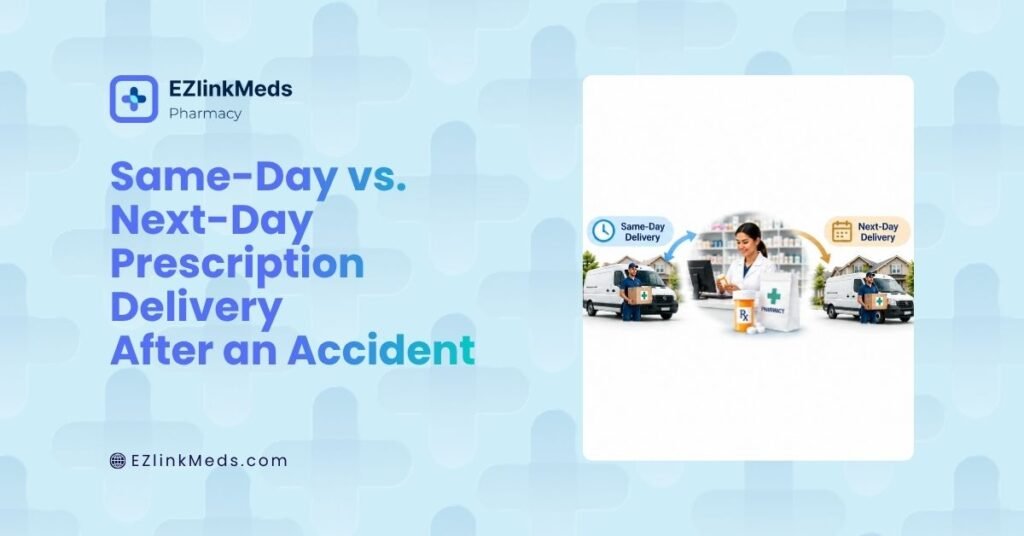


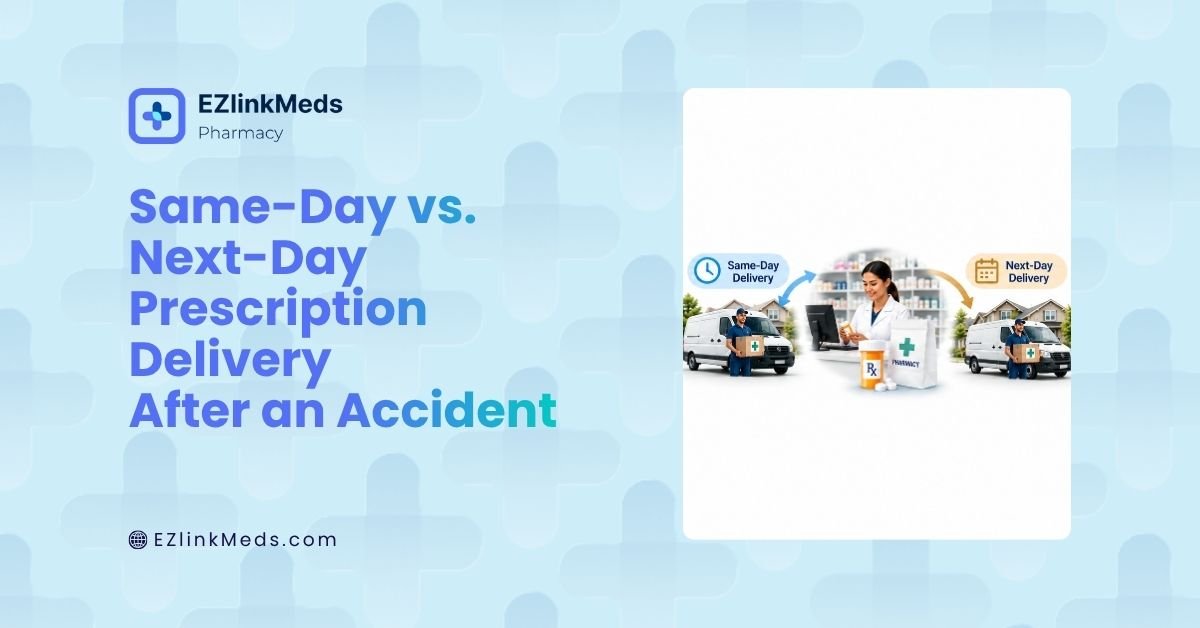
Same-day prescription delivery after an accident may be available when the prescription is ready to dispense in time for an available delivery window. An early request alone does not guarantee same-day service.
The pharmacy must first complete the required prescription and pharmacist review, confirm medication availability, and address any applicable personal-injury billing setup. Delivery then depends on factors such as the address, cutoff time, and route capacity.
In short, delivery speed depends on prescription readiness plus delivery readiness. The pharmacy should confirm the actual delivery window before same-day or next-day service is expected.
Key takeaway
- Same-day delivery depends on readiness, not request time alone. The prescription must first be legally and operationally ready to dispense before a delivery window can be confirmed.
- Several factors can affect timing. Prescription validity, pharmacist review, medication stock, personal-injury billing setup when applicable, delivery area, cutoff time, route capacity, and patient availability can all influence whether same-day or next-day delivery is available.
- One incomplete step can move the delivery window. Prescriber clarification, unavailable medication, incomplete case or payment information, or a missed operational cutoff may shift an otherwise eligible order to a later delivery window.
- Confirm timing with the pharmacy. Patients and case contacts should wait for the pharmacy to confirm the actual delivery window before relying on same-day or next-day service.
What Determines Same-Day vs. Next-Day Prescription Delivery?
Same-day versus next-day availability depends on two things coming together: the prescription must be ready for lawful dispensing, and the delivery operation must be able to accept it for the requested window.
A same-day request is therefore not the same as confirmed same-day delivery. Even an early request may move to a later window when prescription clarification, pharmacist review, medication availability, case-payment setup, or delivery logistics are still unresolved.
Several pharmacy and delivery factors must align before same-day or next-day availability can be confirmed.
| Availability Factor | Same-Day More Likely When… | Next-Day or Later More Likely When… |
| Prescription Status | A valid prescription has been received and does not require clarification. | The prescription is missing, incomplete, requires clarification, or a new prescription is needed. |
| Pharmacist Review | Required pharmacy review can be completed without unresolved issues. | The pharmacist needs additional information, prescriber contact, or medication-specific review. |
| Medication Availability | The prescribed medication, strength, dosage form, and quantity are available. | The medication needs to be sourced or an issue with the prescribed medication must be resolved. |
| Case / Billing Setup | Any requested personal-injury payment arrangement has been accepted, and the necessary information is complete. | Case documents, billing information, payment-arrangement approval, or other administrative review remains incomplete. |
| Delivery Location | The confirmed address is within the available delivery area and can be served during the requested window. | The address falls outside the available route or requires a different delivery window. |
| Cutoff and Route Capacity | The prescription becomes ready before the applicable cutoff, and the route has capacity. | It becomes ready after the cutoff or the available route is already at capacity. |
| Patient Contact / Consultation | The patient or appropriate recipient can be reached, and applicable consultation requirements can be addressed. | Contact or recipient information is unclear, the patient cannot be reached when needed, or consultation still needs to be addressed. |
The practical question is therefore not simply, “What time was delivery requested?” It is “Which required pharmacy, case, and delivery steps are complete when the available route is being finalized?”
For the broader process that happens before a prescription reaches the delivery stage, see how accident prescriptions are filled: from prescriber to pharmacy to patient.
The prescription has to be ready before the delivery clock really starts
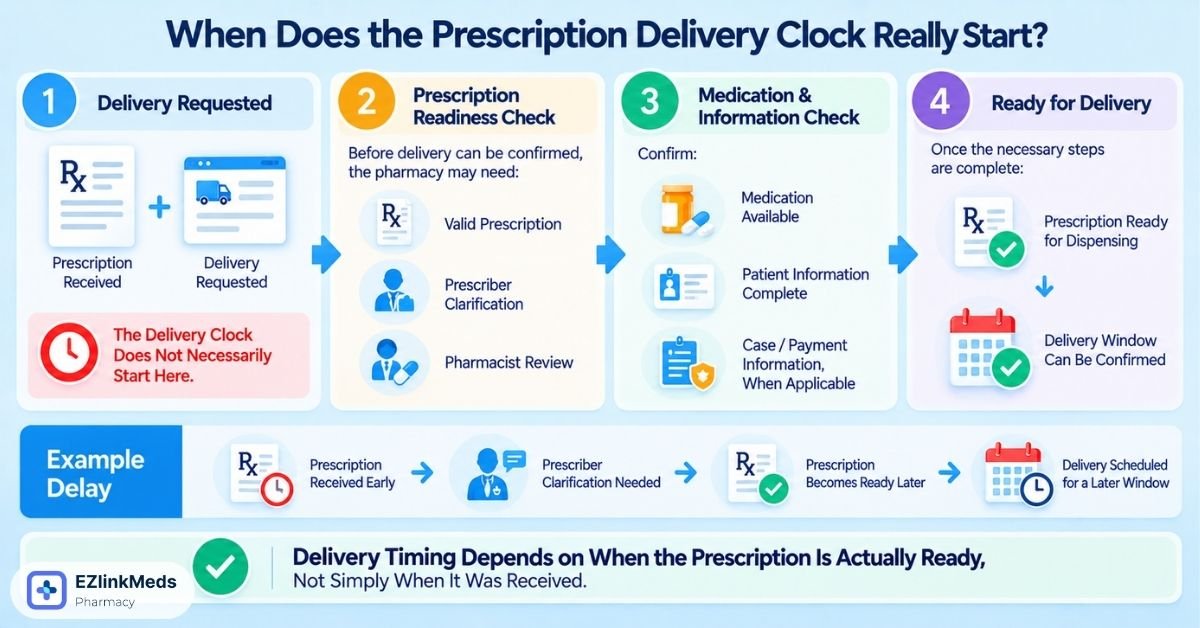
A delivery request can be submitted early, but timing depends on when the prescription is actually ready for dispensing. Before delivery can be confirmed, the pharmacy may need:
- A valid prescription
- Any necessary prescriber clarification
- Required pharmacist review
- The prescribed medication to be available
- Necessary patient information
- Applicable case or payment information when personal-injury billing is requested
These steps may not happen at the same time. A prescription received early, for example, may still be delayed if the pharmacy needs clarification from the prescriber.
Refills also require appropriate authorization. See how prescription refills work during an active personal injury case for details.
Medication availability can move an order to the next delivery window
Even when a prescription is otherwise ready, medication availability can affect whether it reaches the current delivery window. The pharmacy needs the prescribed medication, strength, dosage form, and quantity available before it can be dispensed.
If the medication needs to be sourced or the prescription requires clarification, delivery may move to a later window. The pharmacy cannot simply alter the prescription solely to make same-day delivery possible. Any change must follow applicable pharmacy requirements and, when required, involve the prescriber.
Medication-specific requirements, including those for controlled substances, may also affect review and timing.
If the prescription is currently at another pharmacy, a transfer may need to occur first. See how to transfer an accident-related prescription to a new pharmacy for details.
Personal-injury billing or lien setup can affect operational readiness
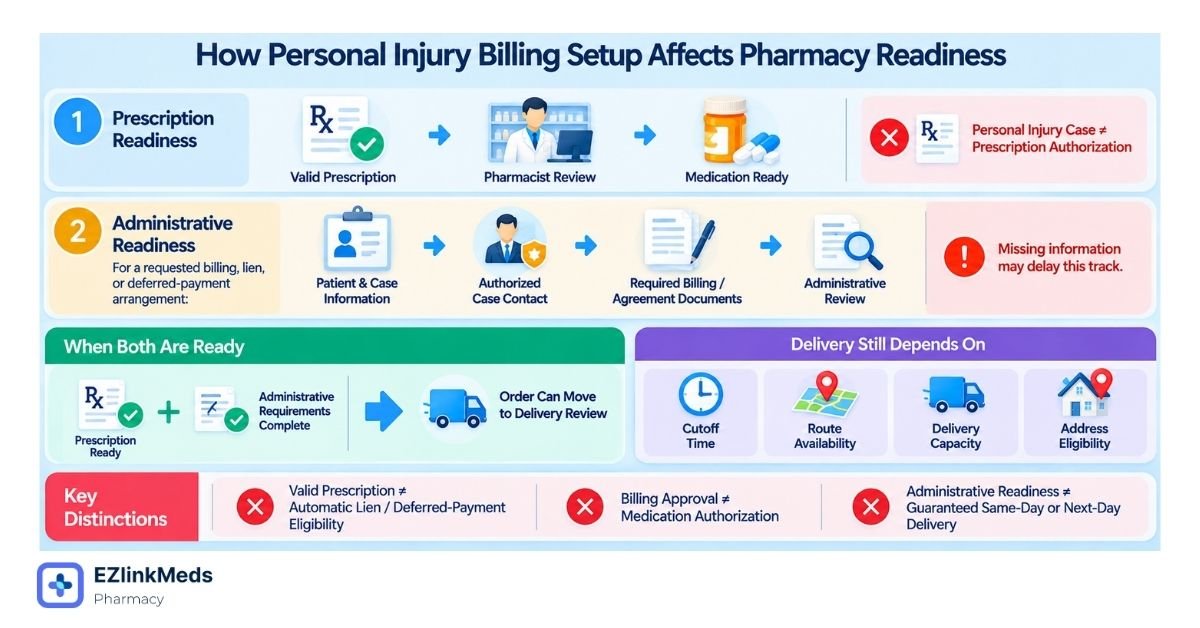
When a patient requests a personal-injury billing, lien, or deferred-payment arrangement, the pharmacy may need a separate administrative review before releasing the prescription under that arrangement.
This may involve confirming patient and case information, identifying an authorized case contact, and obtaining applicable billing or agreement documents. Missing information can delay the process even when the prescription itself is valid.
This process is separate from medication authority. An active personal injury case, attorney involvement, or payment arrangement does not create a prescription or override pharmacist review. An accident-related prescription also does not automatically qualify for lien or deferred-payment treatment.
Providing case information early may reduce administrative delays, but it does not guarantee same-day or next-day delivery. Prescription readiness and delivery capacity must still align.
Delivery area, cutoff time, and route capacity determine the actual window
A prescription can be ready to dispense and still miss the requested delivery window. Once the pharmacy side is complete, delivery location, operational cutoff, and available route capacity help determine whether same-day or next-day service is available.
Three practical questions matter:
- Is the delivery address within the available service area? An address outside the active route or service area may require a different delivery option or window.
- Did the prescription become ready before the applicable cutoff? A prescription that becomes ready later in the day may no longer fit that day’s delivery schedule.
- Does the current route have capacity? Even an otherwise ready prescription may move to the next available window when the route is already committed.
These factors explain why two prescriptions requested at the same time may have different delivery windows. One may already be ready and fit an available route, while the other may become ready after that route has been finalized.
Exact delivery areas, cutoff times, and service windows can change with current operations.
Patients should rely on the delivery window confirmed by the pharmacy rather than assuming that an early request automatically qualifies for same-day service.
What can patients and case managers do to reduce avoidable delivery delays?
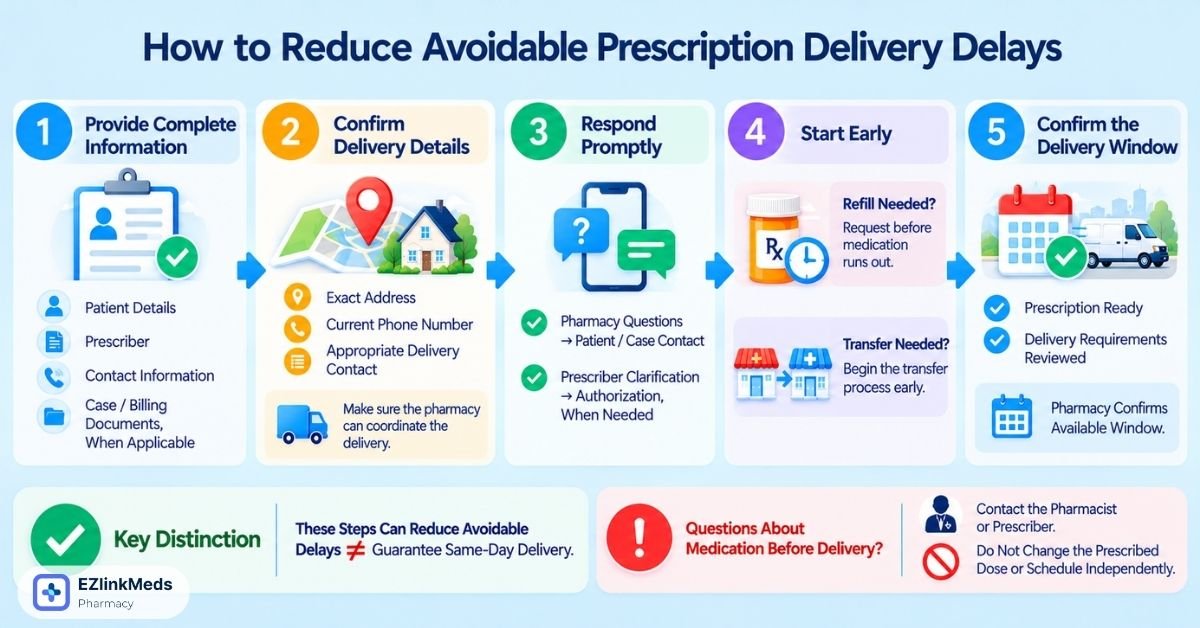
Patients and case managers cannot control every factor affecting accident medication delivery, but they can reduce delays caused by missing information, unresolved authorization, or incomplete delivery details.
Provide Complete Information Early
Make sure the pharmacy has accurate patient and prescriber information, including current contact details. When a personal-injury payment arrangement is requested, promptly provide the attorney or authorized case contact and any applicable case or billing documents the pharmacy requests.
Confirm the Delivery Address and Phone Number
Provide an accurate delivery address and a phone number where the patient or appropriate contact can be reached. Missing or incorrect information can interfere with delivery coordination.
Respond to Pharmacy or Prescriber Requests
A prescription may need clarification or additional authorization before the pharmacy can proceed. Responding promptly to pharmacy communications can help prevent avoidable delays.
Start Refills and Transfers Early
Request refills before the current medication supply is exhausted so there is time to address any required authorization. When a prescription is at another pharmacy, begin the transfer process early when possible.
Confirm the Delivery Window With the Pharmacy
Completing these steps does not guarantee same-day delivery. Ask the pharmacy to confirm the actual available delivery window after the prescription and applicable delivery requirements have been reviewed.
If a delay creates questions about how to take the medication before the prescription arrives, contact the pharmacist or prescriber rather than changing the prescribed dose or schedule independently.
How do you confirm whether same-day or next-day delivery is available?
The most reliable way to determine delivery timing is to have the pharmacy review the actual prescription and delivery details. A general request for same-day service is not enough to confirm that the prescription can enter that day’s route.
To evaluate the available delivery window, the pharmacy may need:
- Patient name and current contact information
- Prescription or prescriber information
- Current pharmacy information if a transfer may be needed
- Accurate delivery address
- Attorney or authorized case contact when applicable
- Case and billing information required for the requested payment arrangement
- Requested delivery timing
The pharmacy can then determine what remains incomplete, whether the prescription can proceed toward dispensing, and whether an available delivery window can accommodate the order.
Request a Delivery-Availability Review With EZlinkMeds
Patients, providers, or authorized case contacts can provide the relevant prescription, patient, case, and delivery information to EZlinkMeds for review. Once the necessary information is available, the applicable delivery window can be determined based on prescription readiness and current delivery availability.
Same-day or next-day delivery should be considered confirmed only after the pharmacy verifies the individual order and available delivery window.
Conclusion
Same-day versus next-day prescription delivery depends on more than when the request is submitted. The prescription must first be ready for dispensing, while medication availability, applicable case or billing setup, delivery location, cutoff timing, route capacity, and patient contact can all affect the available window.
Providing complete information early can help reduce avoidable delays, but it does not guarantee same-day service. The most reliable approach is to have the pharmacy review the individual prescription and confirm the available delivery window before making plans around its arrival.