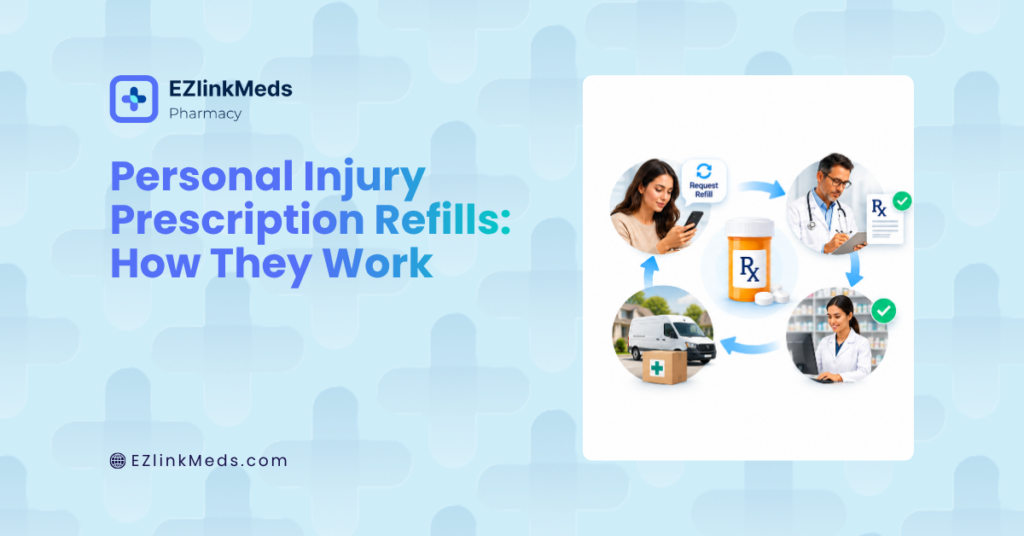



The accident prescription process starts with a valid prescription from an authorized prescriber. The pharmacy receives the order, completes the required pharmacist review, and determines whether the medication can be lawfully dispensed. When personal injury billing is requested, case and payment information may be reviewed separately.
Think of the process as two parallel lanes: Medication Authority covers the prescription, pharmacist review, and dispensing, while Case Administration covers applicable billing, case documents, and delivery coordination. An active personal injury case, attorney involvement, or lien arrangement does not create or modify prescription authority.
Once the necessary requirements are satisfied, the medication can be prepared and dispensed for pickup or eligible delivery. Later refills or pharmacy transfers follow their own requirements.
Key takeaway
- The accident prescription process begins with a legally valid prescription from an authorized prescriber. An active personal injury case, attorney involvement, or lien arrangement does not create prescription authority.
- After receiving the prescription, the pharmacy must review it and complete the necessary steps to prepare, label, verify, and lawfully dispense the medication before it can be picked up or delivered.
- Personal injury billing or lien setup is a separate administrative process. The pharmacy may need case, attorney, or billing information before using the requested payment arrangement, but that information does not replace prescription or pharmacist requirements.
- Refills and pharmacy transfers come later in the medication workflow and have their own rules. Patients who need another dispensing or want to change pharmacies should follow the appropriate refill or transfer process rather than assuming the original prescription automatically covers the next step.
How does an accident prescription get from the prescriber to the patient?
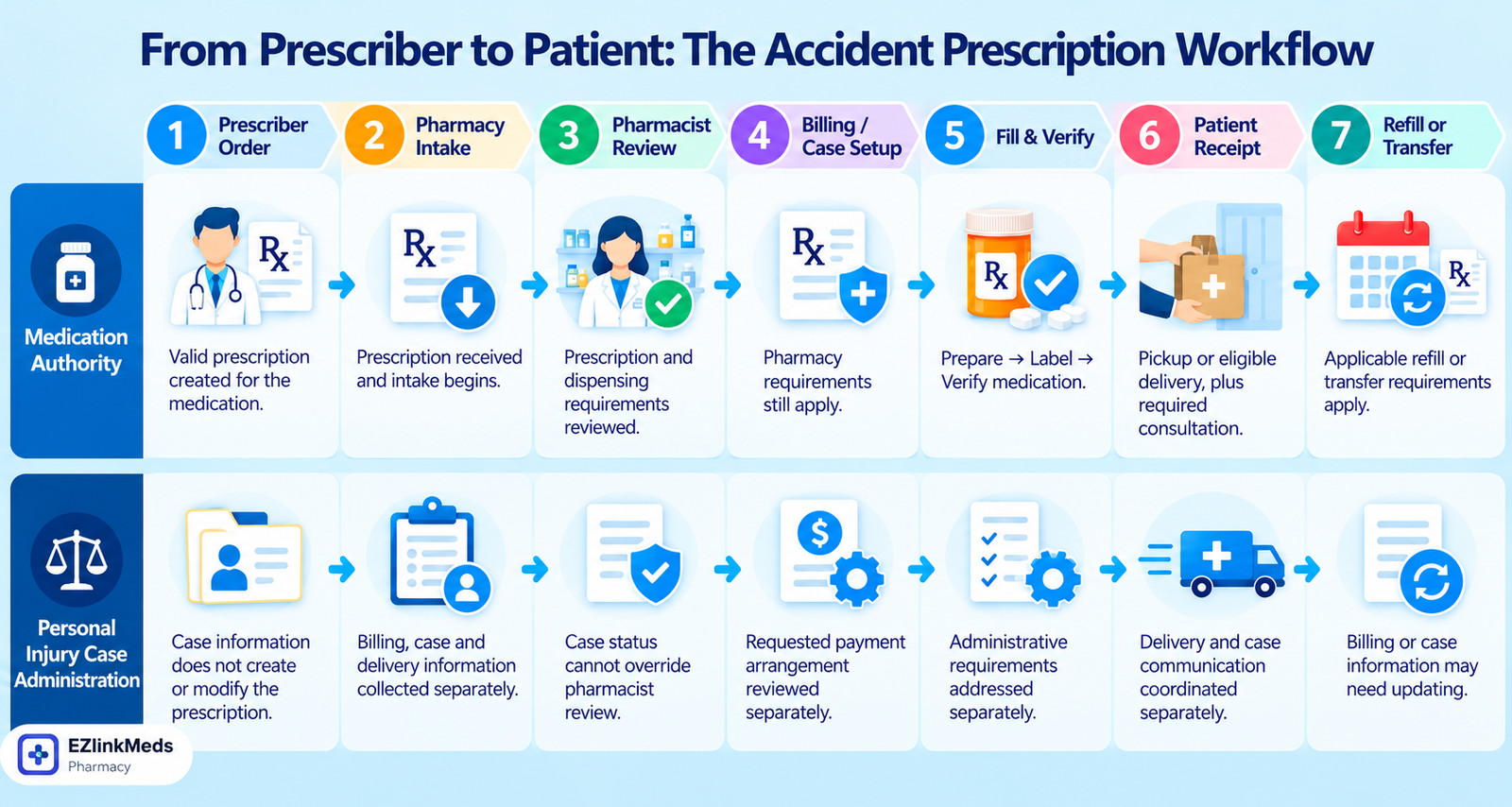
An accident-related prescription generally moves through seven stages, from the prescriber’s order to pharmacy review, dispensing, pickup or delivery, and later refill or transfer needs.
Two parallel lanes run through this process:
- Medication Authority covers the prescription, pharmacist review, dispensing, and later refill or transfer requirements.
- Case Administration covers applicable personal injury billing, case documents, contacts, and delivery coordination.
Case administration can support the process, but it cannot replace prescription authority or pharmacist review.
Receiving the prescription is therefore only the first step. The pharmacy still needs to review and lawfully dispense it, while any personal injury payment arrangement follows a separate administrative track.
Step 1 – The prescriber sends a valid prescription
The accident prescription process begins with an authorized prescriber issuing a valid prescription for the patient. The personal injury claim may explain why the patient is receiving treatment, but it does not create or change the prescription itself.
Most California prescriptions are sent electronically
California generally requires prescriptions to be issued as electronic data transmission prescriptions, subject to statutory exceptions. The electronic prescription is transmitted to the patient’s chosen pharmacy, where the pharmacy can begin its intake and review process.
Exceptions exist, so a prescription is not automatically invalid simply because it was issued through another legally permitted method. The pharmacy determines whether the prescription it receives satisfies the applicable requirements.
Prescription authority comes from the prescriber
The prescriber determines the medication order, including the drug, strength, directions, quantity, and authorized refills where applicable.
An attorney, case manager, lien agreement, or active claim cannot create or modify a prescription. If clarification or a prescription-related change is needed, the pharmacy may need to contact the prescriber before dispensing.
Step 2 – The pharmacy receives and reviews the prescription
Once the pharmacy receives the accident medication prescription, the next step is intake and pharmacist review. Receipt alone does not mean the prescription is automatically ready to be filled.
Pharmacy intake comes first
The pharmacy records the prescription and confirms the information needed to process it. This can include the patient’s identifying information, the prescriber, medication, strength, directions, quantity, and other prescription details.
The pharmacy may also collect or update patient information needed to process the prescription and maintain applicable pharmacy records. If information is incomplete, unclear, or requires confirmation, the pharmacy may need to contact the prescriber before moving forward.
Personal injury information can be collected during this stage as well, but it remains a separate administrative process. Attorney or case details do not replace information required for the prescription itself.
The pharmacist reviews the prescription
Before dispensing, the pharmacist reviews the prescription and applicable patient-safety and legal requirements. Controlled substances may require additional review under state and federal law.
An active personal injury case, attorney involvement, or billing arrangement cannot override the pharmacist’s professional responsibilities. If clarification or additional information is needed, the prescription may require further review before filling.
Step 3 – Personal-injury billing or lien setup happens separately
Once the prescription reaches the pharmacy, any personal injury billing or lien arrangement is handled as a separate administrative process. A valid prescription establishes medication authority, but it does not automatically determine how the medication will be paid for.
The pharmacy may need separate case information
When a patient requests a personal injury billing or deferred-payment arrangement, the pharmacy may need additional case information. Depending on the pharmacy’s requirements and the proposed arrangement, this may include:
- Patient and personal injury case details
- Attorney or other authorized case contact information
- Relevant billing information
- A signed lien or deferred-payment agreement, where applicable
- Other documentation needed to review the requested arrangement
The pharmacy must separately determine whether the requested arrangement can be accepted and whether the necessary documentation is complete. A prescription does not automatically qualify for lien or deferred-payment billing simply because it relates to an accident.
For more detail, see how prescription liens work after an accident in california and what documents are needed to set up a prescription lien?
Case approval does not replace pharmacy review
Even when case documentation is complete, the prescription must still meet applicable pharmacy requirements and pass pharmacist review. An attorney, active claim, or billing arrangement cannot create prescription authority or guarantee dispensing.
The payment arrangement only addresses how charges may be handled under the applicable agreement. Once the prescription and required case-administration steps are addressed, the medication can move toward filling and final verification.
Step 4 – The pharmacy fills, verifies, and dispenses the medication
Once the prescription has passed the necessary review and, where applicable, the requested payment arrangement has been addressed, the pharmacy can move toward preparing, verifying, and dispensing the medication. Receiving a prescription does not guarantee immediate dispensing.
The medication is prepared and verified
The pharmacy prepares and labels the medication according to the prescription and completes final verification before release. Medication availability, prescriber clarification, controlled-substance requirements, or other issues identified during pharmacist review may affect the process.
Pharmacist consultation may be required
California requires pharmacist consultation in specified situations, including when a medication is new to the patient or when certain prescription details, such as strength or directions, change.
Delivery does not eliminate access to consultation. For delivered prescriptions, the pharmacy must provide notice of the patient’s right to consultation and a way to obtain it.
Once the applicable dispensing requirements are satisfied, the prescription can move to pickup or eligible delivery.
Step 5 – The patient receives the prescription by pickup or delivery
After the pharmacy completes its review, preparation, and verification, the medication can be released through an available pickup or delivery pathway.
Pickup After Dispensing
For pickup, the medication is provided after applicable dispensing requirements are completed, including pharmacist consultation when required. Patients should wait for the pharmacy to confirm that the prescription is ready rather than assuming it is available as soon as the prescriber sends it.
Delivery When Available
Some accident-related prescriptions may be eligible for delivery depending on the medication, location, pharmacy services, and other applicable requirements.
Delivery does not remove the patient’s right to pharmacist consultation, and an authorized prescription does not guarantee a particular delivery time.
What Happens When the Patient Needs a Refill or Wants to Change Pharmacies?
After the initial prescription is dispensed, the patient may need another authorized dispensing or may want to move the prescription to a different pharmacy. These are separate processes, and neither happens automatically because the personal injury case remains active.
When the Patient Needs a Refill
For an accident-related prescription refill, the pharmacy may need to:
- Check whether authorized refills remain
- Confirm that the prescription still supports another dispensing
- Determine whether additional prescriber authorization is required
- Apply any medication-specific or controlled-substance requirements
- Separately confirm that applicable case or billing information remains current
An active claim, attorney involvement, or personal injury billing arrangement does not add refills or extend prescription authority.
For the complete process, see how prescription refills work during an active personal injury case.
When the Patient Wants to Change Pharmacies
If the patient wants to use a different pharmacy, the next steps can depend on:
- Whether the prescription has already been filled
- Whether authorized refills remain
- Whether the medication is controlled
- Whether the prescription is eligible for transfer under applicable requirements
- Whether the receiving pharmacy needs separate personal injury case or billing information
Transferring an eligible prescription does not automatically transfer an existing lien, deferred-payment arrangement, case documentation, or delivery setup.
For the complete transfer process, see how to transfer an accident-related prescription to a new pharmacy.
In either situation, Medication Authority and Case Administration remain separate. The pharmacy determines the appropriate prescription pathway while separately addressing any case-related information that needs to be updated.
What Commonly Delays an Accident Prescription?
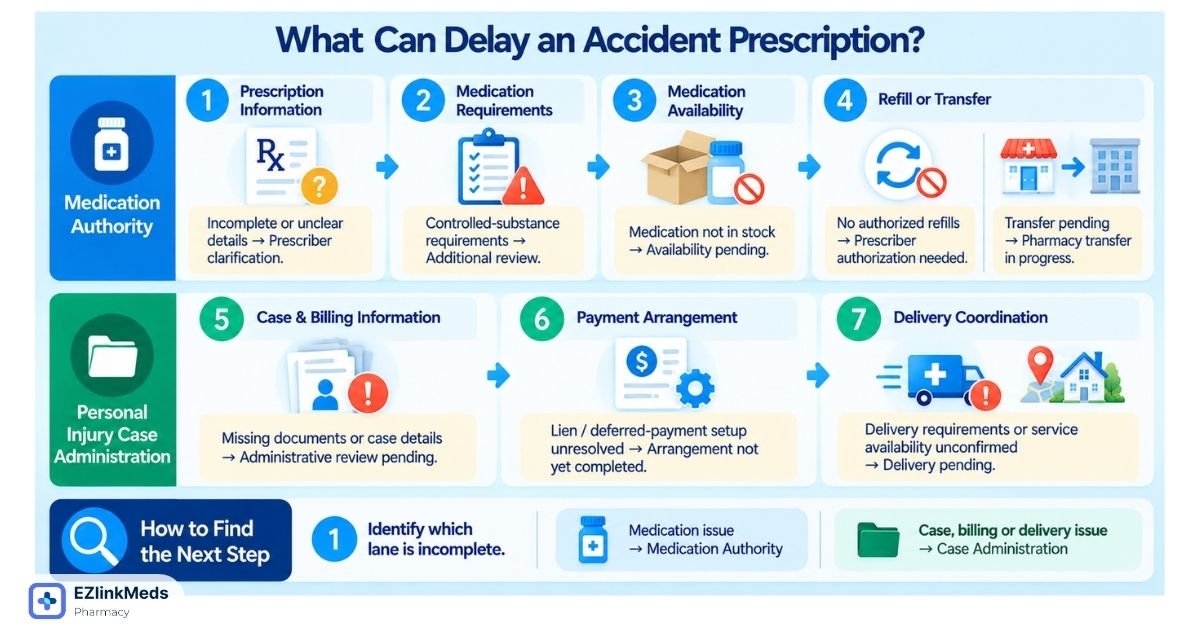
An accident prescription can be delayed at several points between the prescriber and the patient. A delay does not necessarily mean the prescription was denied. It may mean that information, authorization, medication availability, case documentation, or another step still needs to be resolved.
What can delay the fill?
Common workflow issues include:
- Incomplete or unclear prescription information that requires additional review or prescriber clarification
- Prescriber clarification when the pharmacy needs confirmation before dispensing
- Controlled-substance requirements that require additional legal or pharmacist review
- Medication availability when the prescribed medication is not currently in stock
- Missing case or billing information when a personal injury payment arrangement is requested
- Unresolved lien or deferred-payment setup when the pharmacy has not yet accepted or completed the requested arrangement
- No authorized refills remaining when additional prescriber authorization is required
- A pending pharmacy transfer when the prescription is being moved from another pharmacy
- Delivery or service constraints when delivery is requested but the applicable requirements have not yet been confirmed
The fastest way to identify the next step is usually to determine which lane is incomplete. A prescription-related issue belongs to the Medication Authority lane, while missing case, billing, or delivery information generally belongs to Case Administration.
Providing complete information early can reduce avoidable back-and-forth, but it does not guarantee that a prescription will be filled, accepted under a particular payment arrangement, or delivered within a specific timeframe.
What should patients, attorneys, and providers send to the pharmacy?
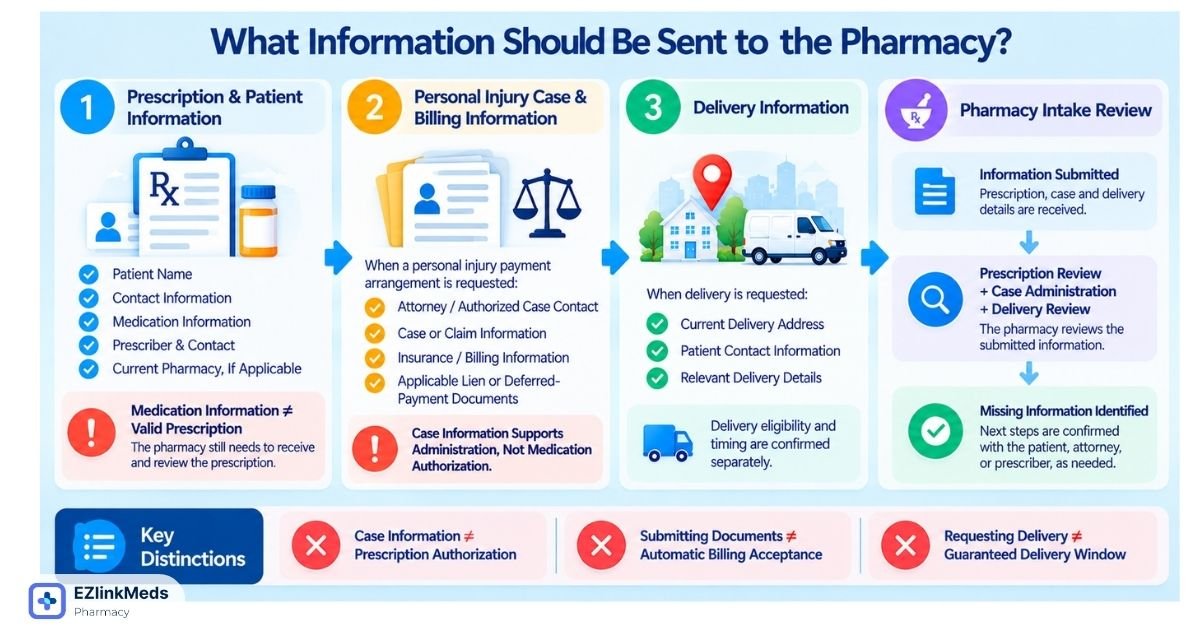
Providing complete information at the beginning of the accident prescription process can help the pharmacy identify missing prescription, case, billing, or delivery details before they create avoidable delays.
Prescription and Patient Information
The pharmacy may need:
- Patient name and contact information
- Prescription or medication information, if available
- Prescriber name and contact information
- Current pharmacy information, when a transfer may be involved
The pharmacy still needs to receive and review the prescription itself. Providing medication information does not substitute for a valid prescription from an authorized prescriber.
Personal Injury Case and Billing Information
When a personal injury payment arrangement is requested, provide the applicable:
- Attorney or authorized case contact
- Case or claim information
- Insurance or billing information
- Lien or deferred-payment documentation, where applicable
The exact documentation depends on the pharmacy’s requirements and the proposed payment arrangement. Case information supports administration but does not authorize medication or guarantee that a particular billing arrangement will be accepted.
Delivery Information
If delivery is requested, provide the patient’s current delivery address and contact information. Delivery eligibility and timing still need to be confirmed separately based on the medication, location, pharmacy services, and other applicable requirements.
Begin the Pharmacy Intake Process With EZlinkMeds
Patients, providers, or authorized case contacts can provide EZlinkMeds with the prescription and prescriber information, patient details, and relevant case or billing contacts to begin a pharmacy intake review.
EZlinkMeds can then identify which prescription, case-administration, or delivery information still needs attention before the process can move forward. Prescription acceptance, dispensing, personal injury billing arrangements, medication availability, and delivery remain subject to the applicable pharmacy and operational review.
Conclusion
Filling an accident-related prescription involves more than sending an order to a pharmacy. The prescription must move through pharmacy intake, pharmacist review, preparation, verification, and dispensing, while any personal injury billing or case requirements are handled separately.
Keeping Medication Authority and Case Administration aligned can help reduce avoidable delays. Complete prescription, prescriber, patient, and applicable case information gives the pharmacy what it needs to identify the next step.
Patients, providers, and authorized case contacts can contact EZlinkMeds to begin a pharmacy intake review and determine what prescription or case information may still be needed.