



A prescription lien after an accident generally refers to an arrangement that allows a pharmacy to dispense prescribed medication while payment is deferred under agreed terms. Payment may then be addressed as the patient’s personal injury case progresses or is resolved.
The arrangement does not make the medication free or change the requirements for filling a prescription. A valid prescription is still required, and the pharmacy and pharmacist must follow applicable dispensing requirements.
For patients, the process is best understood as a lifecycle rather than a single form. It can involve case review, a written agreement, prescription fulfillment, account tracking, communication during the personal injury case, and eventual account resolution. The exact payment terms, including what happens after a recovery or when a case produces no recovery, depend on the signed agreement and applicable law.
Key takeaway
- A prescription lien after an accident can allow eligible prescriptions to be dispensed while payment is deferred under a written agreement.
- The arrangement does not make medication free or replace California prescription and dispensing requirements.
- The process may include case review, prescription fulfillment, balance tracking, case coordination, and eventual account resolution.
- How the pharmacy balance is handled after a settlement, insufficient recovery, or no recovery depends on the signed agreement and applicable law.
What is a prescription lien after an accident?
A prescription lien, sometimes called a pharmacy lien or medication lien, commonly describes an arrangement in which accident-related prescriptions are dispensed while payment is deferred under written terms. The pharmacy maintains a balance that may later be addressed in connection with the personal injury case.
The arrangement affects payment timing, not whether a medication can lawfully be dispensed. A valid prescription and applicable dispensing requirements still apply.
A prescription lien is best understood as a lifecycle rather than a single form:
Prescription Lien Lifecycle Ledger |
||
|---|---|---|
| Lifecycle Stage | What Must Be Verified | Primary Reader Question |
| Case Review | Claim context and pharmacy acceptance criteria | Can this case be reviewed? |
| Agreement | Written terms and required acknowledgments | What am I agreeing to? |
| Prescription | Valid prescription and dispensing requirements | Can the pharmacy fill it? |
| Fulfillment | Pharmacist review, availability, and pickup or delivery options | How do I receive it? |
| Account Tracking | Fills, charges, records, and balance | How is the balance tracked? |
| Case Coordination | Appropriate communication among involved parties | Who communicates with whom? |
| Settlement or Recovery | Recovery, agreement terms, and applicable obligations | How is payment handled? |
| No or Insufficient Recovery | Case outcome and agreement terms | What happens if recovery is unavailable or insufficient? |
| Closeout | Payment or other documented resolution | When is the account resolved? |
The exact process can vary by pharmacy, agreement, prescription, and case. Most importantly, deferred payment does not mean free medication, and the financial arrangement does not replace lawful dispensing requirements.
How is a prescription lien created in California?
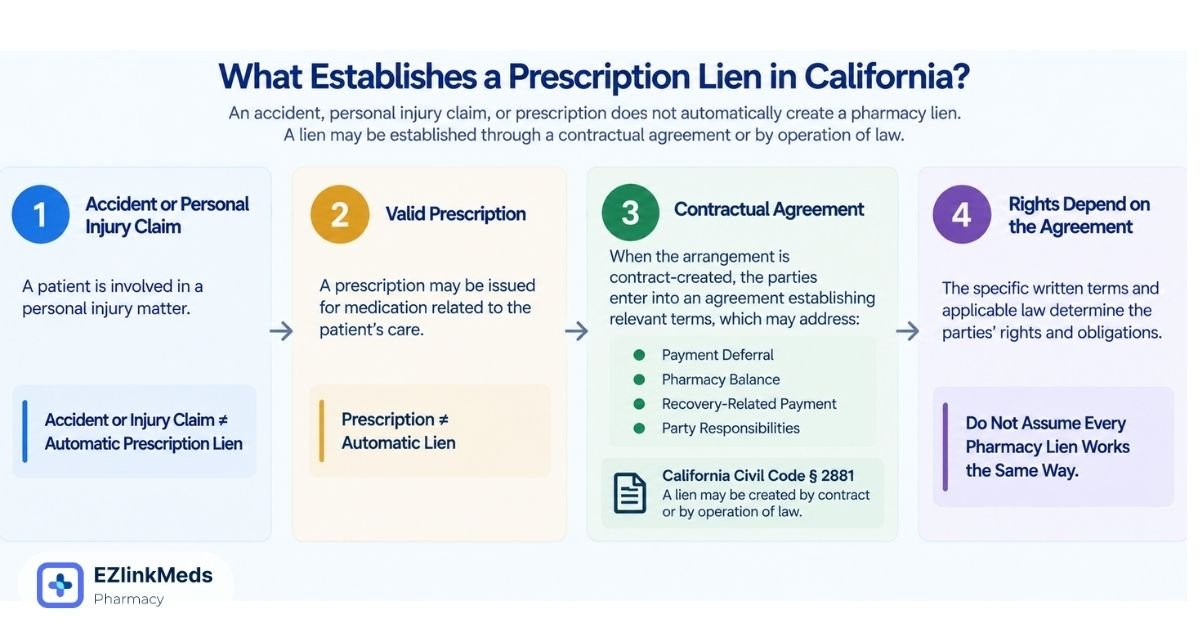
A prescription lien in California is not automatically created by an accident, a personal injury claim, or the issuance of a prescription. When the arrangement is contractual, it depends on an agreement establishing the relevant payment terms and responsibilities.
Contract-Created Pharmacy Liens
California Civil Code § 2881 recognizes that a lien may be created by contract or by operation of law. A private pharmacy lien or deferred-payment arrangement may therefore depend on contractual terms rather than a pharmacy-specific statutory lien. The written agreement is important when determining the rights and obligations of the parties.
Depending on its terms, the agreement may address payment deferral, how the pharmacy balance is handled after a settlement or other recovery, and the responsibilities accepted by the parties. These terms should be reviewed rather than assuming every prescription lien works the same way.
Pharmacy Liens vs. Statutory Hospital Liens
A contractual pharmacy arrangement is different from California’s statutory hospital-lien framework. Civil Code § 3045.1 is part of the statutory hospital-lien framework and addresses qualifying charges of licensed hospitals and hospital-affiliated health facilities. It should not be treated as automatically creating the same statutory lien for an independent retail or community pharmacy.
Questions about the enforceability, priority, or effect of a particular pharmacy agreement depend on its terms and applicable law and may require individualized legal review.
Who can use a pharmacy lien?
Not every accident-related prescription automatically qualifies for a pharmacy lien or deferred-payment arrangement. Eligibility depends on the pharmacy’s current acceptance criteria and the circumstances of the individual case.
At a high level, the pharmacy may review:
- Personal Injury Case Context: Whether there is an accident-related personal injury matter that can be considered under the pharmacy’s current policies.
- Valid Prescription: Whether the patient has a prescription that can lawfully be dispensed.
- Case Information: Whether sufficient information is available to review the case and proposed payment arrangement.
- Required Agreement: Whether the patient and any other required parties complete the applicable lien or deferred-payment documents.
- Attorney or Case-Manager Information: Whether legal-team contact information is needed for the arrangement or ongoing case coordination.
Having an attorney, an insurance claim, or an accident-related prescription does not by itself establish eligibility. The pharmacy must first determine whether the case and prescription can be handled under its current policies. Patients can review who may qualify for a pharmacy lien after a personal injury for a more detailed look at the qualification process.
What Paperwork Sets Up the Arrangement?
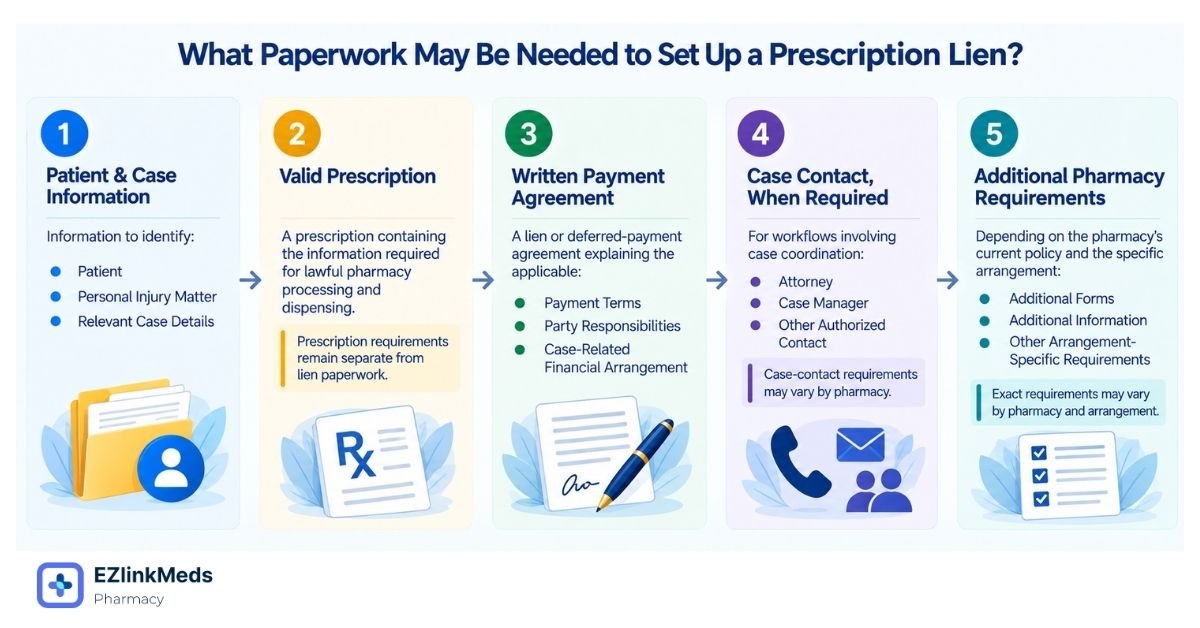
Setting up a prescription lien or deferred-payment arrangement generally requires enough information to connect the patient, prescription, personal injury case, and payment terms. The exact documents depend on the pharmacy’s current requirements and the arrangement being offered.
At a high level, setup may involve:
- Patient and case information to identify the patient and relevant personal injury matter
- A valid prescription containing the information required for lawful dispensing
- A written lien or deferred-payment agreement explaining the applicable financial terms
- Attorney or case-manager information, when required for case coordination
- Any additional forms or information required under the pharmacy’s current policy and the specific arrangement
These financial and case documents do not replace the prescription itself or the pharmacy’s dispensing requirements. They establish the payment and coordination framework surrounding the prescription. Patients and legal teams can review the documents needed to set up a prescription lien for the more detailed setup requirements.
How are accident prescriptions filled and delivered?
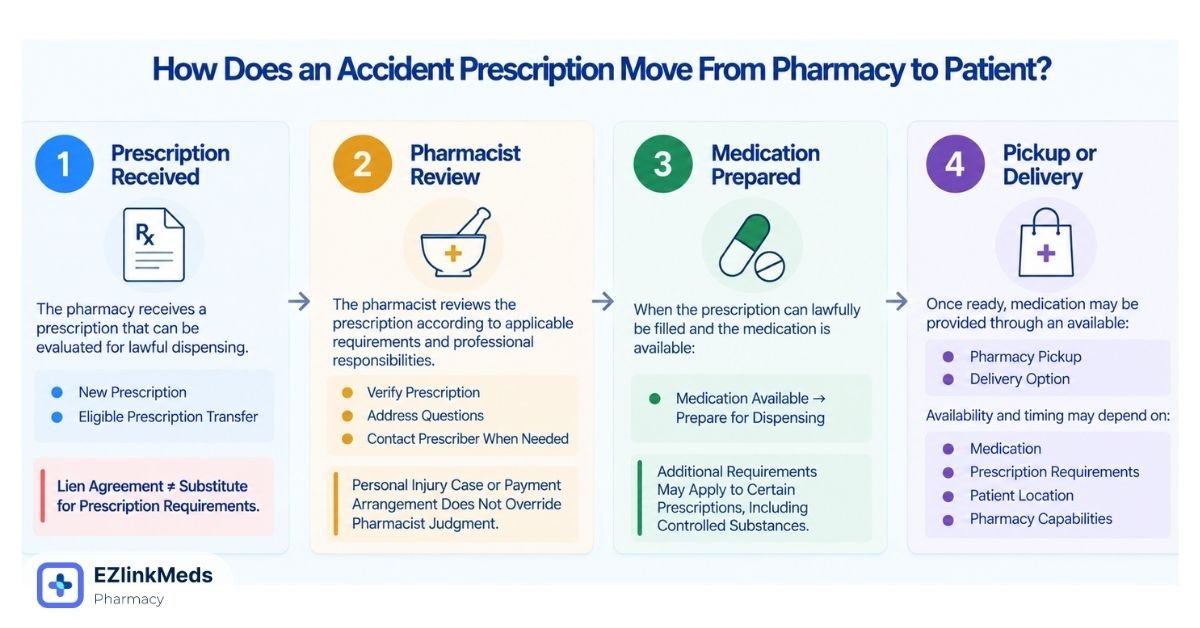
Once the financial arrangement is established, the prescription still moves through the pharmacy’s review and dispensing process. A lien or deferred-payment agreement changes how payment may be handled, but it does not make a prescription automatically fillable.
Prescription Received
The pharmacy must receive a prescription that can lawfully be dispensed. When an existing prescription is transferred from another pharmacy, the transfer must comply with applicable prescription-transfer requirements.
The prescription must contain the information required under applicable pharmacy law. The California State Board of Pharmacy’s Pharmacy Law Book provides the current California pharmacy-law framework governing prescription and dispensing requirements. The lien arrangement does not substitute for, modify, or eliminate these requirements.
Pharmacist Review
Before dispensing, the pharmacist reviews the prescription according to applicable pharmacy requirements and professional responsibilities.
Questions or issues identified during this process may need to be addressed before the medication can be dispensed. The existence of a personal injury case or deferred-payment agreement does not override the pharmacist’s judgment.
Medication Availability and Dispensing
If the prescription can lawfully be filled and the medication is available, the pharmacy can prepare it for dispensing. Availability can vary by medication, and additional requirements may apply to certain prescriptions, including controlled substances. The financial arrangement remains separate from these dispensing requirements.
Pickup or Delivery
After the prescription is ready, the medication may be provided through an available pickup or delivery option. Delivery availability and timing can depend on factors such as the medication, prescription requirements, patient location, and the pharmacy’s current capabilities. A lien arrangement by itself does not guarantee a particular delivery method or timeframe.
How is the pharmacy balance tracked during the personal injury case?
Once prescriptions are dispensed under a deferred-payment arrangement, the pharmacy account may continue to change as the patient receives additional fills or refills.
Keeping the account current helps the patient and other authorized parties understand what has been dispensed and the balance associated with the arrangement.
Account information may include:
- Prescription fills and refills
- Charges associated with dispensed medications
- Current pharmacy balance
- Relevant account or case-status updates
- Records or balance information requested by authorized parties
Case coordination may involve the patient, pharmacy, prescribing provider, attorney, or case manager. The coordination between attorneys, case managers, providers, and a personal injury pharmacy can include appropriate prescription, account, and case-related communication. What information may be shared, and whether patient authorization is required, depends on the purpose of the communication and applicable privacy requirements.
The HHS HIPAA Privacy Rule permits covered entities to make certain uses and disclosures of protected health information for treatment, payment, and health care operations without a separate patient authorization. Other disclosures may require authorization or another legal basis.
Tracking a pharmacy balance does not give the pharmacy automatic priority over settlement proceeds or guarantee payment from a recovery. Settlement handling depends on the agreement and applicable law.
What Happens When the Personal Injury Case Settles?
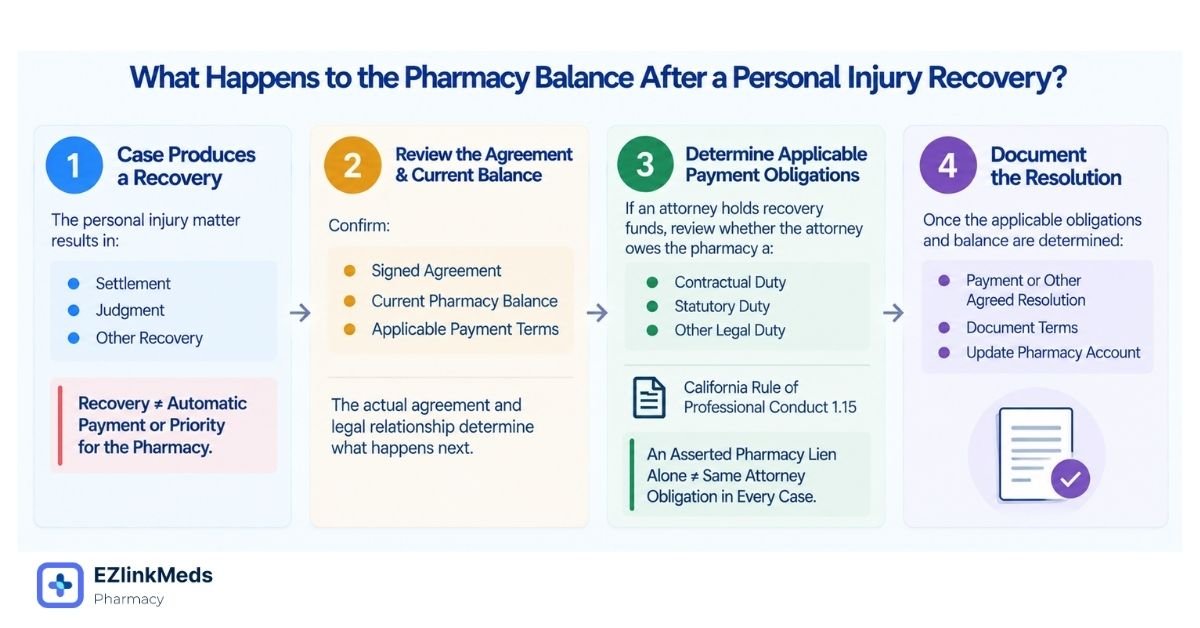
When a personal injury case results in a settlement, judgment, or other recovery, the pharmacy balance may be addressed according to the signed lien or deferred-payment agreement. Recovery does not automatically determine how much the pharmacy receives or give the pharmacy priority over other claims.
The current balance and agreement should be reviewed to determine the applicable payment terms. If an attorney is holding recovery funds, the attorney’s responsibilities toward the pharmacy depend on the legal relationship involved.
California Rule of Professional Conduct 1.15 governs funds received or held for a client or another person to whom the attorney owes a contractual, statutory, or other legal duty.
Whether Rule 1.15 creates duties concerning a particular pharmacy claim depends on the contractual, statutory, or other legal relationship involved and the specific circumstances. An asserted pharmacy lien alone should not be treated as creating the same obligation in every case.
Once the applicable obligations and balance are determined, any payment or other agreed resolution can be documented and the pharmacy account updated.
What If the Case Does Not Settle or the Recovery Is Too Small?
A personal injury case that produces no recovery does not create one automatic outcome for a pharmacy lien.
There may be no settlement or judgment proceeds available for payment, but that does not by itself mean the pharmacy balance disappears or becomes personally due.
The signed lien or deferred-payment agreement is central to determining what happens next. Its terms may address no-recovery outcomes, patient payment responsibility, continued deferral, or the possibility of a reduction or waiver. These outcomes should not be assumed unless supported by the applicable agreement or policy.
Insufficient recovery is different from no recovery. If the patient receives some money but the amount is not enough to satisfy all outstanding claims or balances, the agreement and applicable circumstances determine how the pharmacy balance is addressed. A smaller recovery does not automatically require the pharmacy to reduce or waive its balance.
For a detailed explanation of what happens to a pharmacy lien if a personal injury case does not settle, including no-recovery and insufficient-recovery situations, see the dedicated guide.
What should a patient confirm before agreeing to a prescription lien?
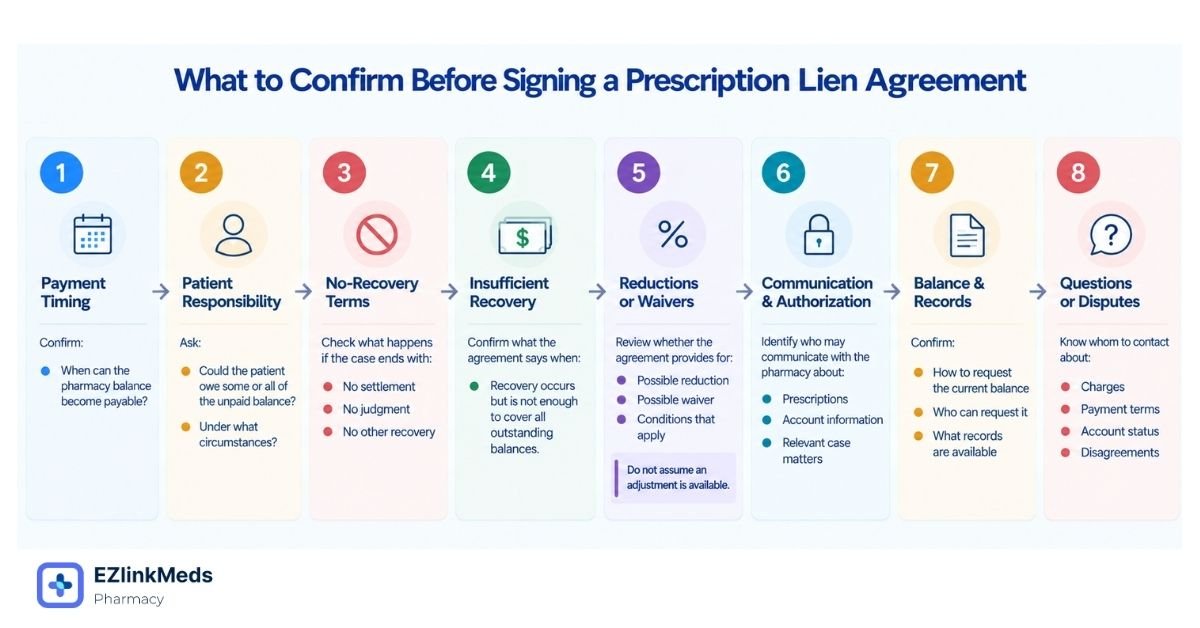
Before signing a prescription lien or deferred-payment agreement, patients should understand how the arrangement works beyond simply receiving medication without immediate payment.
Key terms to confirm include:
- Payment timing: When can the pharmacy balance become payable?
- Patient responsibility: Under what circumstances, if any, could the patient be responsible for an unpaid balance?
- No-recovery terms: What does the agreement say if the personal injury case ends without a settlement, judgment, or other recovery?
- Insufficient recovery: What happens if the case produces some recovery but not enough to satisfy all outstanding balances?
- Reductions or waivers: Does the agreement address possible adjustments, and under what conditions?
- Communication and authorization: Who may communicate with the pharmacy about prescriptions, account information, and relevant case matters?
- Balance information: How can the patient or an authorized party request the current pharmacy balance or related records?
- Questions or disputes: Whom should the patient contact if there is a disagreement about charges, payment terms, or account status?
Patients should review the actual agreement rather than assume that all pharmacy lien arrangements use the same terms. Any questions about payment responsibility, no-recovery outcomes, or other financial provisions are best clarified before the arrangement is signed.
Patients and legal teams considering EZlinkMeds can ask how the applicable prescription lien process works and what information may be needed to evaluate an arrangement.
Conclusion
A prescription lien after an accident involves more than postponing a pharmacy bill. The process can include a written agreement, lawful prescription dispensing, account tracking, case coordination, and eventual resolution of the pharmacy balance.
The financial arrangement remains separate from the pharmacy’s dispensing responsibilities, and deferred payment does not mean medication is free. How the balance is ultimately handled depends on the signed agreement, the case outcome, and applicable law.
Patients and legal teams considering EZlinkMeds can ask how the applicable prescription lien process works and what information may be needed to evaluate an arrangement before agreeing to the applicable terms.