

If a personal injury case does not settle, there may be no settlement proceeds available to pay a pharmacy lien. That does not automatically mean the pharmacy balance disappears or becomes personally due. What happens next depends on the signed lien or deferred-payment agreement, the case outcome, any recovery received, and applicable law.
A lien and the underlying payment obligation are related but not identical. California recognizes liens created by contract or operation of law, so the terms of a private pharmacy agreement matter when determining how an unpaid balance is handled.
“No settlement” can also mean different things. A case may be dismissed, denied, abandoned, lost at trial, or closed without recovery. A patient might also receive a judgment or other recovery without a negotiated settlement.
The signed pharmacy agreement should therefore be reviewed before assuming the balance is cancelled, personally owed, or payable from case proceeds.
Key takeaway
- If a personal injury case produces no recovery, there may be no settlement funds available to pay a pharmacy lien, but the pharmacy balance does not automatically disappear.
- The signed lien or deferred-payment agreement is central to determining whether the balance remains payable, stays deferred, may be reduced or waived, or is handled another way, subject to applicable law.
- No recovery and insufficient recovery are different. A case that produces some money may raise different payment and lien issues than a case that produces none.
- Patients and attorneys using EZlinkMeds should review the applicable agreement and confirm the current pharmacy account status before making assumptions about what happens to an unpaid balance.
Does a pharmacy lien disappear if the personal injury case does not settle?
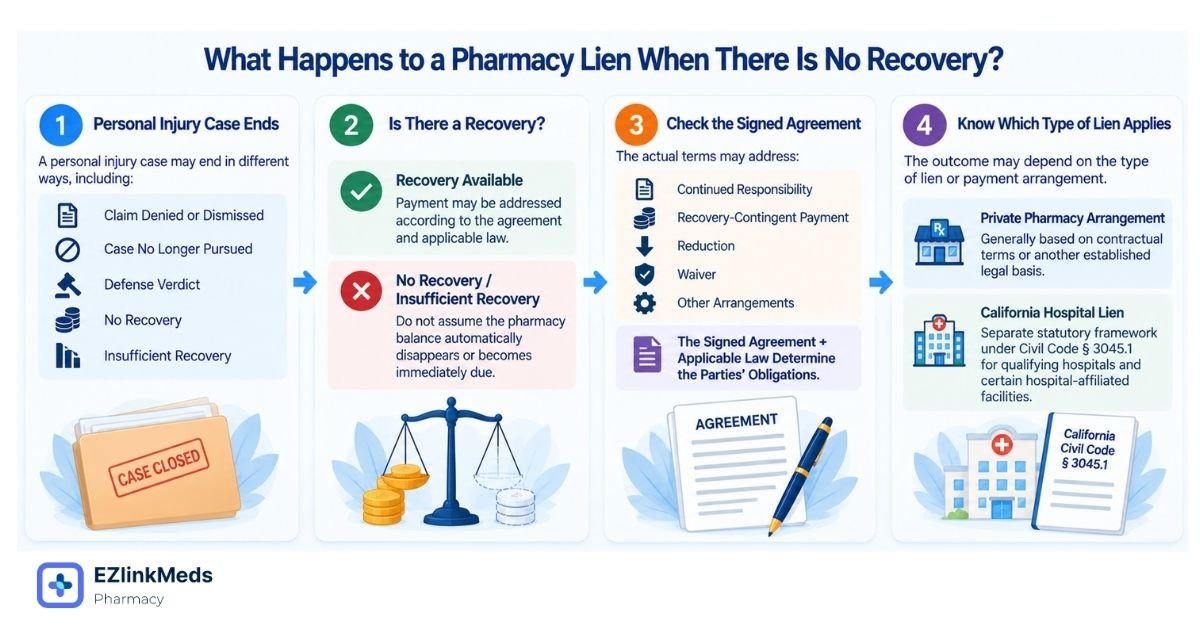
Not automatically. When a personal injury case ends without a settlement, judgment, insurance payment, or other recovery, there may be no recovery fund from which a settlement-linked pharmacy claim can presently be paid. That fact alone does not determine what happens to the underlying pharmacy balance.
The answer depends primarily on the signed lien or deferred-payment agreement and applicable law. Depending on the actual terms, the agreement may address what happens when:
- The claim is denied or dismissed
- The patient or attorney stops pursuing the case
- The case ends in a defense verdict
- The matter closes without any recovery
- Some recovery occurs, but it is insufficient to satisfy all outstanding claims
These outcomes do not automatically erase an unpaid pharmacy balance or make the entire balance personally due. The signed agreement may address continued responsibility, recovery-contingent payment, reduction, waiver, or another arrangement.
A private contractual pharmacy lien should also be distinguished from California’s statutory hospital-lien framework. Civil Code § 3045.1 applies to qualifying hospitals and certain hospital-affiliated health facilities, not ordinary retail or community pharmacies.
When a case ends without recovery, start with the signed pharmacy agreement and the current account status rather than assumptions about what the lien requires. For the broader payment structure, see how prescription liens work after an accident in California.
Why the Signed Pharmacy Agreement Controls the Next Step
When a pharmacy lien is created through a private agreement, the signed document is central to determining what happens after the personal injury case ends. California Civil Code § 2881 recognizes that liens may be created by contract, so the specific terms of that contract matter when evaluating an unpaid pharmacy lien.
The agreement should be reviewed for provisions addressing:
Payment Contingent on Recovery: Does payment become due only if the patient receives a settlement, judgment, or other recovery?
Personal Payment Responsibility: Does the patient agree to remain responsible for any unpaid balance under specified circumstances?
No-Recovery Outcomes: Does the agreement specifically address dismissal, denial, abandonment, a defense verdict, or another outcome with no recovery?
Insufficient Recovery: What does the agreement say when money is recovered but there is not enough to satisfy all outstanding claims or balances?
Reduction or Waiver: Does the agreement permit the pharmacy to reduce or waive a balance, and is that decision discretionary or subject to stated conditions?
Attorney Involvement: Has the attorney acknowledged or assumed any particular responsibilities concerning the pharmacy’s claim or funds received in the case?
Dispute Procedures: Does the agreement explain how questions about the balance, payment responsibility, or claimed entitlement should be addressed?
Attorney Withdrawal or Change of Counsel: Does the agreement address what happens if the attorney withdraws, representation ends, or the patient changes attorneys while the claim remains unresolved?
The exact wording matters. Permission to consider a reduction is not the same as a required waiver, and deferred payment during a pending claim does not necessarily determine what happens when the case closes.
Patients and attorneys should review the signed agreement, applicable law, and actual case outcome rather than rely on general assumptions about pharmacy liens. For setup-document questions, see what documents are needed to set up a prescription lien?
What is the difference between no settlement and no recovery?
“No settlement” and “no recovery” are not always the same thing. A case can end without a negotiated settlement but still produce money through a judgment, insurance payment, or another form of recovery.
By contrast, no recovery means the personal injury claim produced no settlement, judgment, or other recovery from which payment could potentially be made.
The distinction matters because the existence of recovery may affect how the pharmacy agreement and any claimed lien are handled.
How Different Case Outcomes May Affect a Pharmacy Lien |
||
|---|---|---|
| Case Outcome | Are Recovery Funds Available? | What It May Mean for the Pharmacy Arrangement |
| Claim Denied, Dismissed, Abandoned, or Closed Without Recovery | No | There may be no recovery fund available for payment. The signed agreement determines how the underlying balance is handled. |
| Defense Verdict With No Recovery | No | No judgment proceeds are available from the case. The agreement must be reviewed to determine the status of the pharmacy balance. |
| No Negotiated Settlement, but a Judgment or Other Recovery Exists | Yes | The absence of a settlement does not necessarily mean there are no funds. Any pharmacy claim must be evaluated under the agreement and applicable law. |
| Recovery Is Insufficient to Satisfy Outstanding Claims | Yes, but Limited | This is an insufficient-recovery issue rather than a no-recovery case. Payment, reduction, waiver, or other resolution depends on the agreement and applicable circumstances. |
| Pharmacy Claim or Balance Is Disputed | Depends | The existence of funds does not resolve the dispute. The claimed entitlement and applicable legal or contractual obligations may need to be addressed before funds are distributed. |
No Recovery vs. Insufficient Recovery
A case with no recovery has no settlement, judgment, or other recovery available from the personal injury claim. That does not, by itself, establish that the pharmacy balance has been forgiven or that it has become personally payable.
Insufficient recovery is different. The patient has received some recovery, but the available amount may not be enough to satisfy all asserted claims, expenses, or balances. A smaller-than-expected recovery does not automatically require a pharmacy to reduce or waive its balance. Any reduction, waiver, or other adjustment should be supported by the governing agreement, pharmacy policy, or another applicable legal basis.
The key question is therefore not simply, “Did the case settle?” It is also whether any recovery exists and what the signed pharmacy agreement says about that particular outcome.
Can the patient still owe the pharmacy balance?
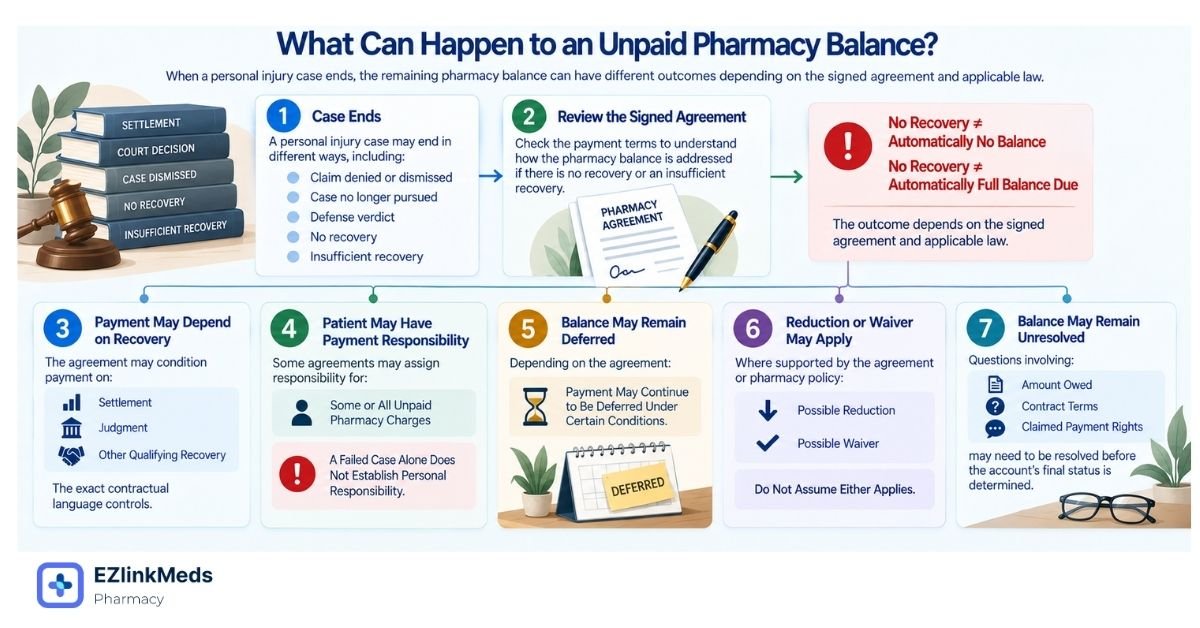
Potentially, but a patient should not assume that an unpaid pharmacy lien automatically becomes a personal debt when the personal injury case ends. The answer depends on the signed agreement, the nature of the underlying payment obligation, and applicable law.
A lien generally serves as security for performance of an act or obligation. California Civil Code § 2909 provides that a lien is accessory to the act for which it serves as security and is extinguishable in the same manner as another accessory obligation. This helps distinguish questions about the lien itself from questions about any underlying payment responsibility after a case produces no recovery.
Depending on the agreement and the circumstances of the case, the pharmacy balance may be handled in several ways:
Payment may be conditioned on recovery
The agreement may state that payment depends on the patient receiving a qualifying settlement, judgment, or other recovery. The exact language should be reviewed before determining what happens when no recovery occurs.
The patient may have payment responsibility
Some agreements may make the patient responsible for some or all unpaid pharmacy charges under specified circumstances. A failed personal injury case alone does not establish that responsibility.
The balance may remain deferred
Depending on the agreement, the balance may remain deferred under certain conditions rather than becoming immediately payable when the personal injury case ends.
A reduction or waiver may be possible
A pharmacy may have contractual terms or policies allowing a balance to be reduced or waived in certain circumstances. A reduction or waiver should not be assumed unless it is supported by the agreement or applicable pharmacy policy.
The balance may be disputed or unresolved
Questions about the amount owed, contractual terms, or the pharmacy’s claimed entitlement may leave the account unresolved. Those issues may need to be addressed before the final status of the balance can be determined.
The same caution applies to a prescription lien after a dismissed case. Dismissal may explain why no recovery is available, but it does not by itself establish what happens to the pharmacy balance.
Patients should review the agreement before assuming they owe nothing or that the full balance has immediately become due. If the wording is unclear, they can request the pharmacy’s current account status and obtain appropriate legal guidance about their specific agreement.
What Happens If the Attorney Is Holding Settlement or Other Recovery Funds?
When a personal injury case produces settlement, judgment, or other recovery funds, the attorney’s responsibilities regarding an asserted pharmacy claim depend on the legal relationship between the parties.
A pharmacy lien or unpaid balance does not, by itself, mean that every attorney automatically has the same obligation to pay it.
California Rule of Professional Conduct 1.15 addresses funds in which a client or another person has an interest. For a pharmacy, the relevant question is whether the attorney owes that third party a contractual, statutory, or other legal duty concerning the funds.
When a Third-Party Interest Exists
If the attorney owes the pharmacy a contractual, statutory, or other legal duty concerning funds being held, Rule 1.15 may require the attorney to safeguard and appropriately handle funds subject to that duty. The precise obligations depend on the facts and the source of the pharmacy’s claimed entitlement.
When the Pharmacy Claim Is Disputed
A dispute over the pharmacy’s claimed entitlement does not automatically determine how the funds should be distributed. When Rule 1.15 applies because the attorney owes the pharmacy a contractual, statutory, or other legal duty, the attorney must comply with the rule’s requirements for safeguarding funds and addressing disputed interests.
The State Bar also explains that lawyers must take diligent steps to initiate and complete the resolution of disputes concerning entitlement to funds or property.
When There Are No Recovery Funds
If the personal injury case produces no settlement, judgment, or other recovery, there may be no recovery funds in the attorney’s possession from which a settlement-linked pharmacy claim can be paid.
That still does not determine whether the underlying pharmacy balance survives, is waived, remains deferred, or is otherwise handled under the signed agreement.
For this reason, the existence of an unpaid pharmacy lien, the status of the underlying balance, and an attorney’s duties concerning recovery funds should be evaluated as related but distinct questions.
What should the patient or attorney do when the case closes without recovery?
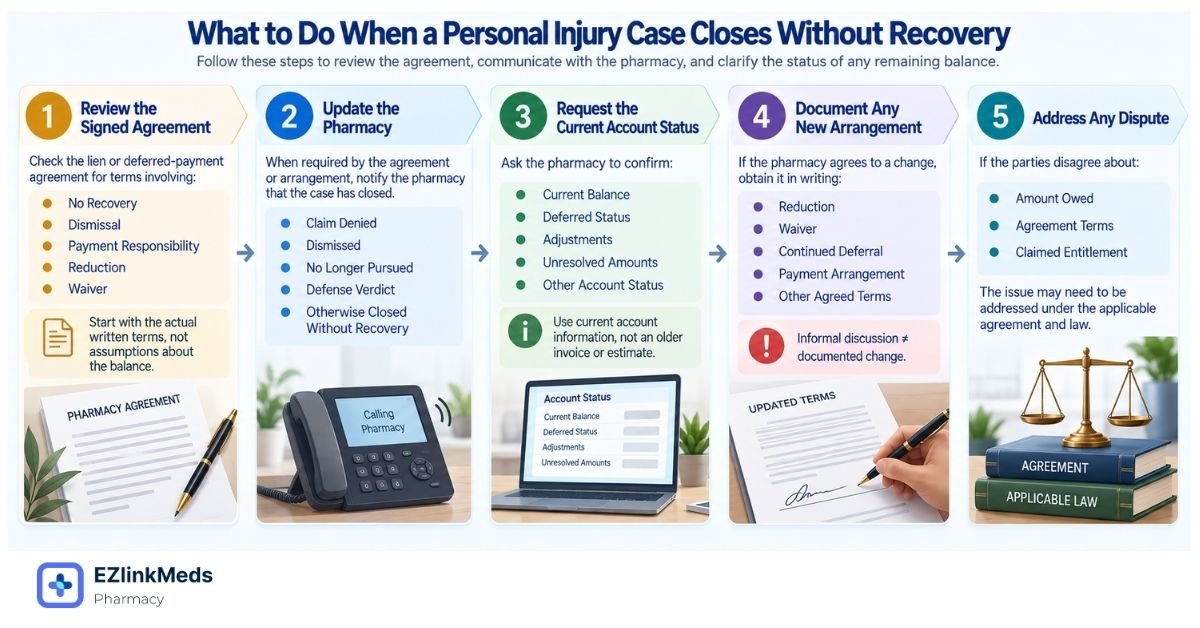
When a personal injury case closes without recovery, the next step is to verify what the signed agreement requires and what the pharmacy currently shows as the account status. Patients and attorneys should avoid assuming that the balance has disappeared or automatically become due.
A practical review should include these steps:
Review the Signed Pharmacy Agreement
Start with the lien or deferred-payment agreement that established the arrangement. Look specifically for terms addressing dismissal, no recovery, payment responsibility, waiver or reduction, and any obligations triggered when the personal injury matter closes.
For more about the paperwork that may establish the arrangement, see What Documents Are Needed to Set Up a Prescription Lien?
Notify the Pharmacy of the Case Outcome
If the pharmacy arrangement depends on the status or recovery of the personal injury matter, the patient or attorney may need to update the pharmacy when the case closes.
Depending on the circumstances and the agreement, this may include notice that the claim was denied, dismissed, abandoned, lost at trial, or otherwise closed without recovery.
Request the Current Balance and Account Status
Ask the pharmacy for current information about the account rather than relying on an older invoice or estimate. This can help clarify the recorded balance and whether the account remains deferred, unresolved, adjusted, or subject to another status under the agreement.
Confirm Any New Arrangement in Writing
If the pharmacy agrees to a reduction, waiver, continued deferral, payment arrangement, or another change, the parties should obtain documentation of the agreed terms. A patient should not assume that an informal discussion has changed the original agreement.
Address Disputed Claims Carefully
If there is a disagreement about the amount, the agreement, or the pharmacy’s claimed entitlement, the parties may need to resolve that issue under the applicable contract and law. The existence of a dispute should not be treated as proof that the balance is either valid or invalid.
The goal is to establish a documented answer to two separate questions: What happened to the personal injury case, and what does that outcome mean for this particular pharmacy account?
What should you confirm before signing a pharmacy lien in the first place?
The best time to clarify what happens after an unsuccessful personal injury case is before the pharmacy agreement is signed. Patients who are still determining who may qualify for a pharmacy lien after a personal injury should address that question separately before reviewing the agreement’s payment terms.
Before signing, consider confirming:
- The agreement should identify who is responsible for the pharmacy balance and under what circumstances. Deferred payment does not necessarily mean the patient can never become responsible for the balance.
- Review what the agreement says if the claim is dismissed, denied, abandoned, lost at trial, or otherwise closed without a settlement, judgment, or other recovery.
- Check how the agreement addresses insufficient recovery, where the case produces some money but not enough to satisfy the pharmacy balance and other amounts claimed from the recovery.
- Determine whether the agreement permits the pharmacy balance to be reduced or waived and under what circumstances. The ability to request or consider an adjustment does not guarantee that one will be granted.
- If an attorney signs an acknowledgment or another document, review the specific responsibilities it creates. Attorney involvement should not be treated as an automatic guarantee that the pharmacy balance will be paid.
- Confirm how questions or disputes about charges, payment terms, account status, or claimed entitlement should be handled and whom the patient or attorney should contact.
Clarifying these terms before medication is dispensed can reduce uncertainty later. Patients and attorneys considering an EZlinkMeds arrangement should review what the pharmacy agreement says about a no-settlement outcome and confirm the current terms before relying on assumptions about payment, reduction, or waiver.
Conclusion
A personal injury case ending without a settlement does not automatically erase a pharmacy lien or make the balance personally due. The outcome depends on the signed lien or deferred-payment agreement, any recovery that exists, and applicable law.
Patients and attorneys should review the agreement, confirm the current pharmacy account status, and document any reduction, waiver, or revised payment arrangement in writing. For an EZlinkMeds account, ask about the current account status and applicable no-settlement terms before making assumptions about the remaining balance.