


Setting up a prescription lien or deferred-payment arrangement usually requires more than a prescription alone. The pharmacy may need patient and case information, a valid prescription, and signed paperwork explaining how payment and case coordination will be handled.
California does not prescribe one universal retail-pharmacy lien form for personal injury prescription arrangements. California Civil Code § 2881 recognizes that liens may be created by contract or by operation of law. Private pharmacy lien or deferred-payment arrangements therefore depend on the applicable agreement rather than a single statewide retail-pharmacy form.
The paperwork generally serves three purposes: confirming who the patient is, whether the prescription can be lawfully filled, and how payment and case coordination will work. A lien agreement does not replace a valid prescription or the pharmacist’s dispensing responsibilities.
Key takeaway
- A prescription lien setup packet generally includes patient and case information, a valid prescription, and the pharmacy’s signed lien or deferred-payment paperwork.
- Attorney or case-manager information may also be required when the pharmacy’s workflow includes case coordination, but there is no single California rule requiring the same packet for every pharmacy.
- Financial paperwork does not replace a valid prescription or the pharmacist’s dispensing responsibilities.
- If required information, signatures, or authorizations are missing, the pharmacy may need to pause the review until the packet is complete.
The Prescription Lien Setup Packet: Core Document Categories
The documents used to establish a prescription lien or deferred-payment arrangement serve different purposes. Some identify the patient and personal injury matter, some are necessary for prescription processing, and others establish the financial and case-coordination arrangement.
Core Documents in a Prescription Lien Setup Packet |
|
|---|---|
| Document Category | Purpose |
| Patient Identification and Contact Information | Connects the Correct Patient With the Prescription, Pharmacy Record, and Applicable Case Information. |
| Valid Prescription | Provides the Prescription Information the Pharmacy Needs to Evaluate and, When Appropriate, Dispense the Medication Under Applicable Pharmacy Requirements. |
| Personal Injury Case Information | Identifies the Claim or Matter Associated With the Requested Deferred-Payment Arrangement. |
| Attorney or Case Manager Information, If Required | Provides a Case Contact When Attorney or Case-Manager Coordination Is Part of The Pharmacy’s Workflow. |
| Lien or Deferred-Payment Agreement | Documents the Parties, Payment Terms, and Obligations Governing the Accepted Arrangement. |
| Attorney Acknowledgment or Similar Document, If Used | May Document an Attorney’s Participation in or Acknowledgment of the Arrangement When Required by the Pharmacy. |
| Prescriber Information | Supports Prescription Verification and Communication With the Licensed Prescriber When Clarification Is Necessary. |
| Patient Authorization, If Needed | Authorizes Specified Information Sharing When Authorization Is Required for a Particular Disclosure or Communication. |
Not every case will necessarily require every document listed above. The specific paperwork depends on the pharmacy’s workflow and the arrangement being established.
One distinction remains especially important: prescription paperwork and financial paperwork are not interchangeable. A signed deferred-payment agreement does not authorize the pharmacy to dispense medication without a valid prescription, and a valid prescription alone does not establish the financial arrangement.
California pharmacy requirements continue to govern prescription processing and dispensing regardless of how payment is arranged. The written lien or deferred-payment agreement separately establishes the applicable financial terms.
Which patient and personal injury case details are needed?
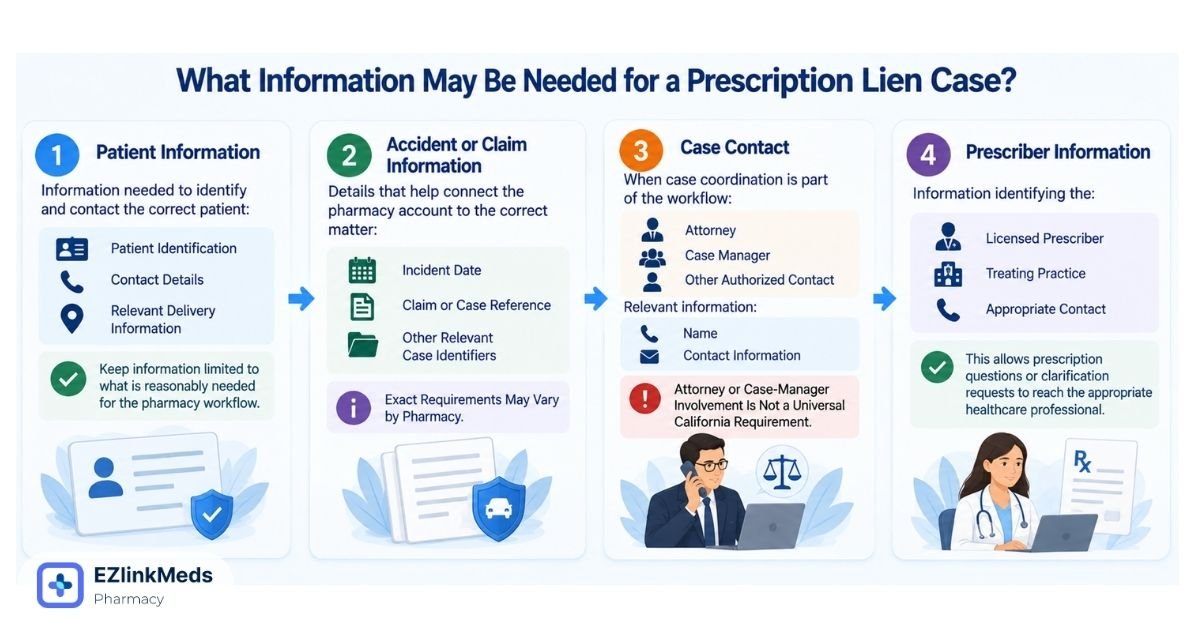
The patient and case-information portion of a prescription lien packet should identify the correct person, connect the pharmacy account to the correct personal injury matter, and provide the contacts needed for case coordination.
The exact fields can vary by pharmacy, so the information requested should match the specific arrangement rather than a presumed statewide intake form.
Patient Identification and Contact Information
Basic identifying and contact details help the pharmacy match the prescription, patient profile, delivery information, and case file to the correct person.
The information requested should be limited to what the pharmacy reasonably needs for prescription processing, communication, billing coordination, and other lawful operations.
Accident or Claim Information
The pharmacy may request enough information to distinguish the personal injury matter associated with the deferred-payment arrangement.
Depending on the workflow, this may include details such as the date of the incident, a claim or case reference, or other identifying information needed to connect the pharmacy account with the correct matter.
Attorney or Case Manager Contact Information
When the pharmacy’s workflow includes case coordination, the packet may request the name and contact information of the attorney, case manager, or other authorized point of contact.
This information helps coordinate communication between attorneys, case managers, healthcare providers, and the pharmacy. However, attorney or case-manager involvement should not be treated as a universal California requirement for every pharmacy lien.
Prescriber or Treating Practice Information
The pharmacy may also need information identifying the licensed prescriber or treating practice associated with the prescription.
This allows prescription-related questions or clarification requests to be directed to the appropriate healthcare professional when necessary. It does not mean the pharmacy needs the patient’s complete medical record simply to establish the financial arrangement.
Limit Information to What Is Actually Needed
A prescription lien packet does not need to become a complete copy of the patient’s personal injury or medical file.
Under the HIPAA Privacy Rule, covered entities generally must make reasonable efforts to limit certain uses, disclosures, and requests for protected health information to the minimum necessary to accomplish the intended purpose. Important exceptions apply, including disclosures to or requests by healthcare providers for treatment and most uses or disclosures made pursuant to a valid patient authorization.
As a practical matter, prescription lien intake should remain focused on information relevant to prescription processing, payment, and case coordination. A patient’s entire medical or litigation file should not be treated as a routine requirement when narrower information is sufficient for the particular purpose.
What prescription and prescriber information does the pharmacy need?
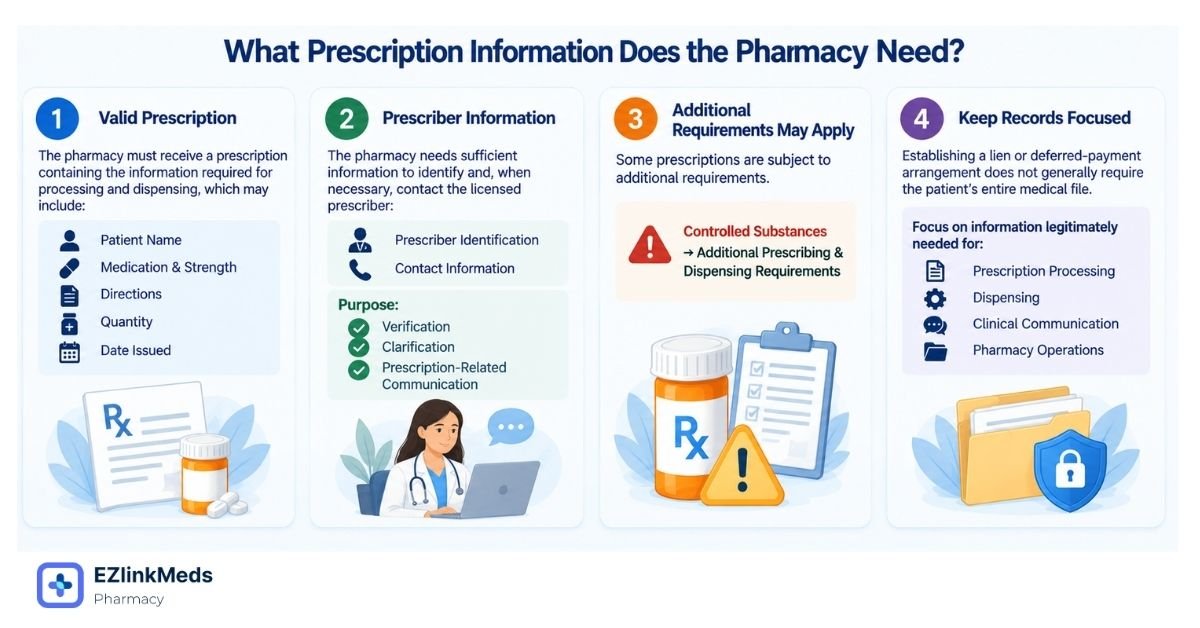
A prescription lien or deferred-payment agreement does not replace the prescription itself. Before medication can be dispensed, the pharmacy must receive a valid prescription and process it according to applicable California pharmacy requirements, regardless of how the prescription charges will be paid.
California law requires prescriptions to contain specified information. Depending on the type of prescription and how it is transmitted, required information can include the patient’s name, the medication and strength, directions for use, quantity, date of issue, and information identifying the prescriber. Additional requirements apply to controlled substances.
For a prescription lien setup, the pharmacy may therefore need:
- A Valid Prescription: The prescription must contain the information required for the pharmacy to process and evaluate it for dispensing.
- Prescriber Identification: The pharmacy needs sufficient information to identify the licensed prescriber who issued the prescription.
- Prescriber Contact Information: Contact information allows the pharmacist to communicate with the prescriber when clarification or other prescription-related communication is necessary.
- Additional Prescription Information When Required: Certain medications, particularly controlled substances, are subject to additional prescribing and dispensing requirements.
The pharmacy does not generally need a patient’s entire medical file simply because a lien or deferred-payment arrangement is being established.
Prescription verification and clinical communication should focus on information legitimately needed for pharmacy operations, while any additional records or disclosures should have an appropriate purpose and follow applicable privacy requirements.
Most importantly, the two parts of the setup remain separate: the prescription supports lawful medication dispensing, while the lien or deferred-payment paperwork establishes the financial and case-coordination arrangement. Completing one does not automatically satisfy the requirements of the other.
Does the attorney need to sign or send documents?
An attorney may need to provide information, acknowledge the arrangement, or sign documentation when those steps are part of the pharmacy’s accepted lien or deferred-payment workflow.
However, California does not impose one universal attorney-signature requirement for every private pharmacy lien arrangement. The documents required depend on the particular agreement and pharmacy process.
When attorney participation is required, the paperwork may serve several purposes:
- Identifying the case contact helps give the pharmacy an appropriate attorney or case-manager contact for permitted case-related communication.
- Acknowledging the arrangement may confirm that the attorney is aware of the pharmacy’s contractual payment arrangement.
- Documenting agreed responsibilities helps clarify any obligations the attorney has specifically accepted under the agreement.
- Supporting payment coordination may establish how the pharmacy and law firm communicate about charges or a potential recovery, subject to the agreement and applicable legal obligations.
A letter of protection or attorney acknowledgment is not required in every California personal injury case. Its relevance depends on the pharmacy’s workflow and the specific agreement being used.
Attorney involvement does not by itself guarantee payment from settlement proceeds. California Rule of Professional Conduct 1.15 addresses funds held for a client or another person to whom the lawyer owes a contractual, statutory, or other legal duty. Whether that rule applies to a particular pharmacy arrangement depends on the specific agreement and applicable law.
For attorney lien documents, patients and case managers should rely on the forms required for the specific pharmacy arrangement rather than assuming a generic acknowledgment or letter of protection will be sufficient.
What should the lien or deferred-payment agreement explain?
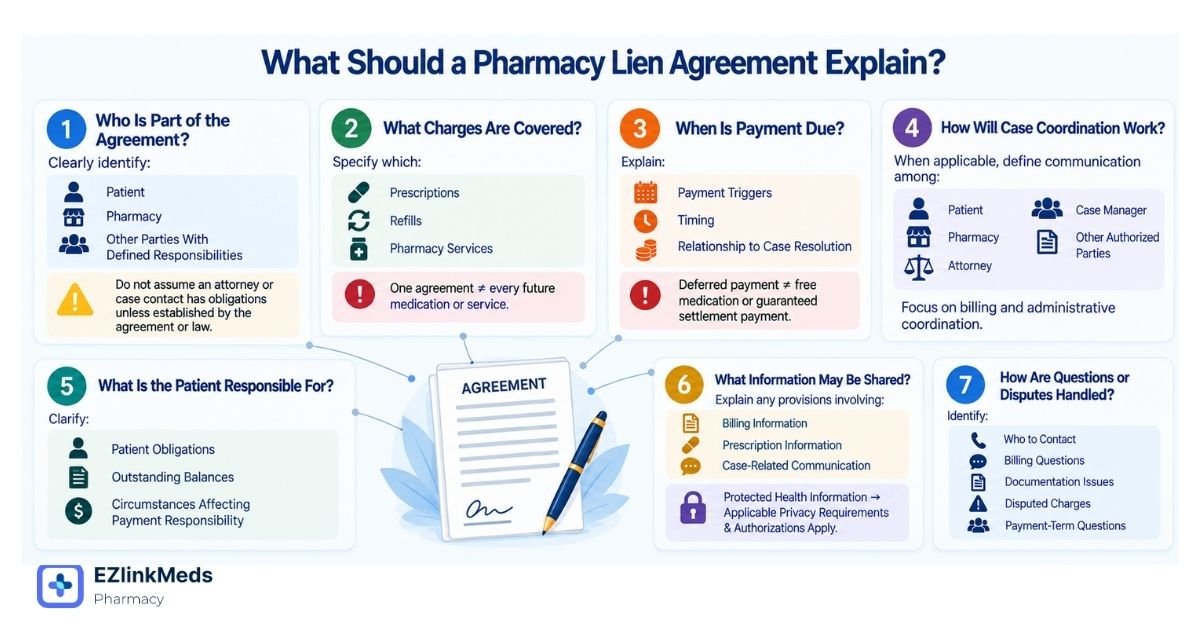
The lien or deferred-payment agreement sets out the financial and case-coordination terms between the parties. For a broader explanation of how prescription liens work after an accident in California, including the overall process beyond document setup, see our complete guide. Because these arrangements are contractual, patients, attorneys, and case managers should rely on the actual written terms rather than assume every pharmacy lien operates the same way.
Who are the parties to the agreement?
The document should identify the patient, pharmacy, and any other person or organization that agrees to specific responsibilities. An attorney or other case contact should not be assumed to have obligations that are not established by the applicable agreement or law.
What prescription charges are covered?
The agreement should identify which prescription charges or pharmacy services are included. Patients should not assume that one agreement automatically applies to every medication, refill, or future pharmacy service.
When does payment become due?
The terms should explain when payment obligations arise and how payment may relate to the progression or resolution of the personal injury case. Deferred payment does not mean that medication is free or that payment from a future settlement is guaranteed.
How will case coordination work?
When case coordination is part of the arrangement, the agreement may address communication among the pharmacy, patient, attorney, case manager, or other authorized parties regarding billing and related administrative matters.
What responsibilities does the patient have?
Patients should review any provisions describing their responsibilities under the arrangement, including circumstances in which an outstanding balance may remain their responsibility. The specific terms of the signed agreement, together with applicable law, determine the parties’ rights and obligations.
For a closer look at payment responsibility when there is no recovery or the recovery is insufficient, see what happens to a pharmacy lien if a personal injury case does not settle?
What information may be shared?
The agreement may contain provisions concerning communication or authorization to share specified information. Any disclosure of protected health information must comply with applicable privacy requirements, including any authorization requirements that apply to the particular disclosure.
How are questions or disputes addressed?
Patients should know whom to contact about prescription charges, documentation, payment terms, or other questions involving the arrangement. Any procedure for addressing disputed charges or other contractual issues should be reviewed before the agreement is signed.
A signed lien or deferred-payment agreement should not be interpreted as a guarantee of payment from settlement proceeds or a guarantee that the patient will never have financial responsibility. The actual agreement and applicable law determine the parties’ obligations.
What Happens If the Document Packet Is Incomplete?
Missing information, signatures, or required forms can delay review of a prescription lien or deferred-payment arrangement. The pharmacy may need to obtain the missing information before it can complete the financial setup, coordinate with the appropriate parties, or move forward with services that depend on an accepted arrangement.
Common issues that may require follow-up include:
Missing Patient or Case Information: Incomplete identifying or claim information can make it difficult to connect the prescription with the correct patient and personal injury matter.
Unsigned or Incomplete Agreements: If a required lien or deferred-payment agreement has not been completed by the necessary parties, the financial arrangement may not yet be established.
Missing Attorney or Case Contact Information: When case coordination is part of the pharmacy’s workflow, missing contact information may prevent the pharmacy from completing required communication or documentation.
Prescription Problems: Missing financial paperwork and prescription issues are separate concerns. Even with a complete lien packet, the pharmacy may still need prescription clarification or other information before medication can be lawfully dispensed.
Missing Authorization, When Required: If particular information must be shared with an attorney, case manager, or another third party, an appropriate patient authorization may be needed depending on the purpose and circumstances of the disclosure.
An incomplete packet does not necessarily mean the case has been rejected. It may simply mean that additional information or signatures are needed before the pharmacy can finish reviewing the requested arrangement.
Patients, attorneys, and case managers can help reduce avoidable delays by checking that requested forms are complete, signatures are included where required, contact information is current, and the prescription has been properly submitted. They should also avoid sending unrelated medical or case records unless the pharmacy identifies a legitimate need for them. Separate pharmacy records and balance requests in personal injury cases may involve different documentation after the account has been established.
What should you send first to start a pharmacy lien review?
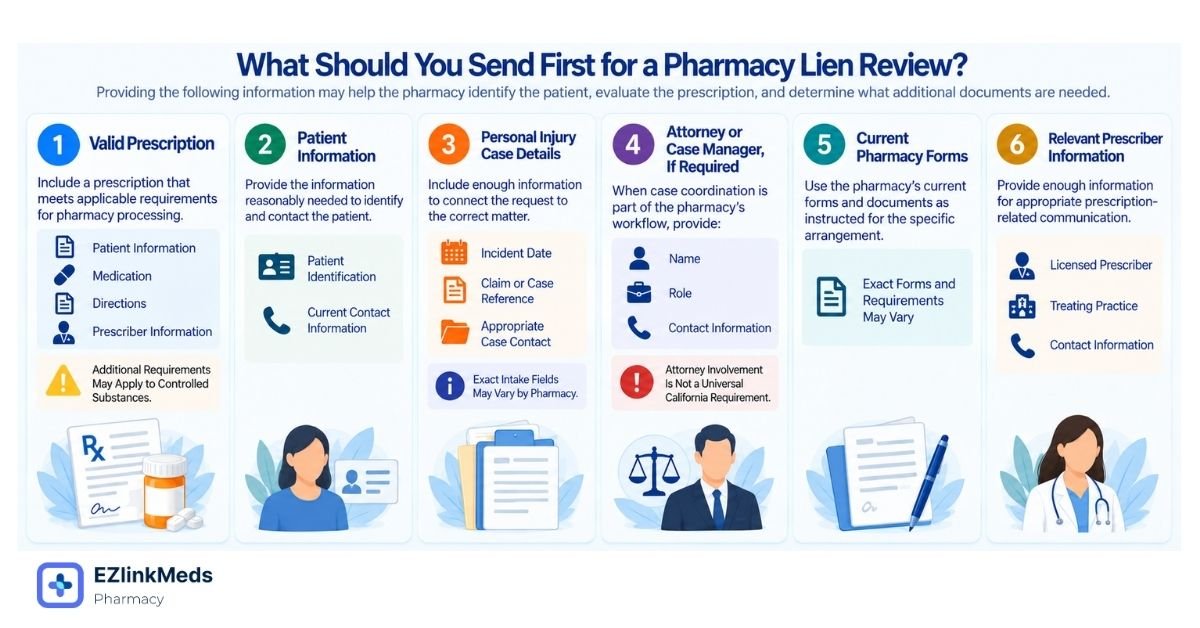
To start a prescription lien document review, the initial packet should generally contain enough information for the pharmacy to identify the patient, evaluate the prescription, and determine what additional paperwork may be needed for the financial arrangement.
Valid Prescription
The pharmacy needs a valid prescription that meets applicable California requirements before medication can be evaluated for dispensing. California law specifies required prescription information, and additional rules may apply to controlled substances.
Patient Identification and Contact Information
Basic patient information helps the pharmacy match the prescription to the correct pharmacy profile and personal injury matter. This may include identifying details and current contact information needed for pharmacy communication.
The goal is to verify the correct patient without collecting more personal information than the pharmacy reasonably needs for the prescription and case-coordination process.
Personal Injury Case Information
The pharmacy may also need basic details that connect the prescription request to the correct personal injury claim or case.
Depending on the pharmacy’s workflow, this may include information such as the date of the incident, a claim or case reference, and the appropriate case contact. The specific fields required can vary, so patients and case coordinators should follow the pharmacy’s current intake instructions.
Attorney or Case Manager Contact Information, If Required
When attorney or case-manager coordination is part of the pharmacy’s workflow, include the appropriate contact information so the pharmacy knows who is authorized to handle case-related communication.
Attorney involvement should not be treated as a universal California requirement for every pharmacy lien arrangement. The need for attorney or case-manager information depends on the pharmacy’s process and the terms of the specific arrangement.
Current Lien or Deferred-Payment Forms
The financial portion of the packet may include the pharmacy’s lien or deferred-payment agreement, acknowledgments, and any required authorizations.
These documents should explain the parties involved and the terms governing payment and case coordination. Patients should use the pharmacy’s current forms rather than relying on a generic lien document because the terms and required signatures can differ between arrangements.
Relevant Prescriber Information
Prescriber information can help the pharmacy verify prescription details and communicate with the licensed prescriber when clarification is needed.
This does not mean the pharmacy automatically needs the patient’s full medical file. The information requested should remain tied to legitimate prescription-processing, clinical, billing, or coordination needs.
Send Only Relevant Supporting Information
Patients, attorneys, and case managers should avoid sending unrelated medical records, complete litigation files, or other broad documentation unless the pharmacy identifies a specific need for that information.
A well-prepared packet should be complete but focused: enough information to identify the patient and case, evaluate the prescription, and establish the requested financial arrangement without collecting unnecessary records.
If you are unsure whether the case itself may qualify before assembling the paperwork, see who qualifies for a pharmacy lien after a personal injury?
Once the requested documents are ready, patients, attorneys, case managers, and referring providers can start a prescription lien document review with EZlinkMeds or ask which current forms are needed for the case. Submission of the packet starts the review process but does not itself guarantee acceptance of the arrangement or dispensing of a particular prescription.
Conclusion
A complete prescription lien setup starts with the right information for the right purpose. Patient and case details establish who the arrangement concerns, a valid prescription supports lawful dispensing, and the lien or deferred-payment agreement explains how financial and case coordination will be handled.
Because there is no single California pharmacy lien form that applies to every personal injury case, the exact paperwork may vary. Patients, attorneys, case managers, and referring providers should use the pharmacy’s current requirements and make sure required information, signatures, and authorizations are complete before relying on the arrangement.
EZlinkMeds can help clarify what paperwork is needed to begin a prescription lien document review. Starting with a focused, complete packet can reduce unnecessary follow-up while keeping prescription requirements separate from the financial agreement.