


Wondering how you’ll pay for your accident-related prescriptions while your case is still pending? Recovering from an accident often involves more than medical treatment. Patients may also be managing follow-up appointments, insurance matters, and questions about how prescription costs will be handled.
Some personal injury pharmacies may offer written billing arrangements for eligible prescriptions, but these arrangements are not the same in every situation.
Confirming the terms before filling a prescription can provide greater clarity about billing, payment timing, and available pharmacy support.
Key takeaway
- A pharmacy lien may be available as a written billing arrangement for eligible accident-related prescriptions, depending on the agreement.
- Pharmacy liens differ from medical provider liens. They generally relate to prescription charges rather than clinical treatment services.
- Review the agreement carefully. Confirm your payment responsibilities, when payment may be due, and what happens if your case does not resolve as expected.
- EZlinkMeds Pharmacy can discuss prescription transfers, available billing options, refill support, and delivery availability for eligible prescriptions.
What Personal Injury Pharmacy Liens May Mean in Southern California
Personal injury pharmacy liens generally refer to written billing arrangements that may be available for eligible accident-related prescriptions. They are not automatic, guaranteed, or the same in every situation.
The terms, payment timing, patient responsibilities, and eligibility requirements depend on the specific agreement and the individual circumstances.
If a pharmacy offers this type of arrangement, patients should review the written agreement carefully before proceeding. It is important to confirm who is responsible for the prescription charges, when payment may be due, what prescriptions are covered, and what happens if the circumstances of the personal injury claim change.
How Do Prescription Liens Work? Key Questions Before Signing
Before signing a pharmacy lien or another deferred-billing arrangement, make sure you understand the terms of the agreement. Because these arrangements vary, asking a few questions can help you understand your responsibilities before your prescription is filled.
- Who signs the agreement? Confirm who must sign the written agreement and whether any additional documentation is required.
- Which prescriptions are eligible? Ask whether the arrangement applies to your accident-related prescription or is determined case by case.
- Who is responsible for payment? Request a clear explanation of your financial responsibilities under the agreement.
- When may payment be due? Confirm when payment obligations may arise and what factors affect the timing.
- What happens if the case does not resolve as expected? Ask how the agreement applies if your claim changes or does not result in a recovery.
- Are collection or billing terms included? Review the agreement for any billing procedures or payment terms that may apply.
- Is attorney involvement required? Ask whether attorney coordination or documentation is needed for your particular situation.
Pharmacy Liens vs. Medical Liens: What Is Different?
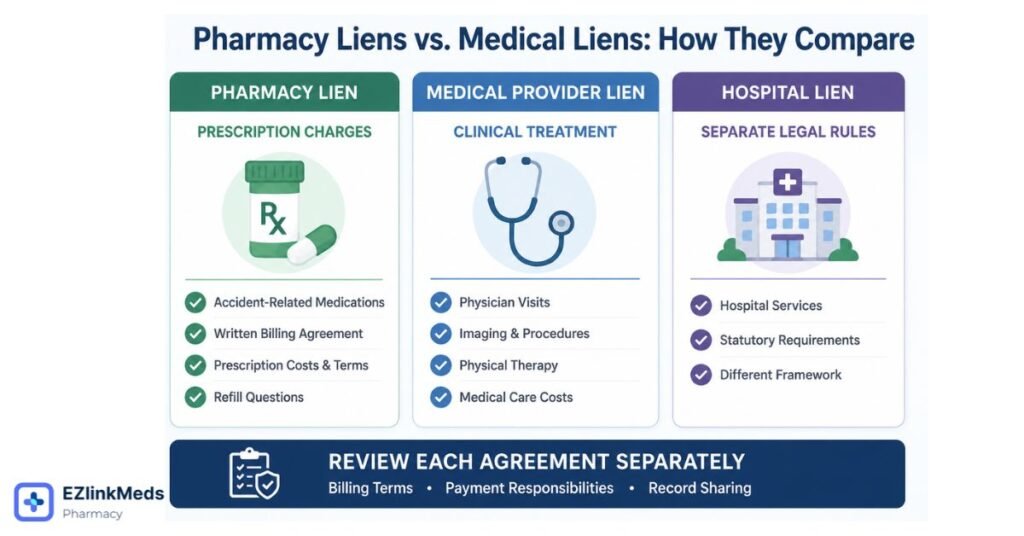
A pharmacy lien and a medical provider lien can both relate to accident-related care, but they generally apply to different services and may involve separate billing arrangements. Here’s a closer look at what each type of billing arrangement may cover and how they can differ.
Pharmacy Liens Focus on Prescription Charges
A pharmacy lien generally relates to the cost of eligible accident-related prescription medications provided under a written billing arrangement. If such an arrangement is available, it applies specifically to pharmacy services rather than medical treatment itself. The agreement typically outlines how prescription charges may be documented, billed, and managed, along with the patient’s responsibilities and any applicable payment terms.
Because pharmacy billing arrangements can vary, patients should ask whether the agreement applies to all prescribed medications or only certain eligible prescriptions, as well as how any future prescription refills may be handled.
Medical Provider Liens Cover Clinical Treatment
Medical provider liens generally relate to healthcare services such as physician visits, diagnostic imaging, surgery, physical therapy, orthopedic treatment, or other clinical care.
Each healthcare provider may use separate billing documents or agreements, meaning prescription charges are not necessarily included within a provider’s medical billing arrangement.
Hospital Liens Follow Separate Legal Rules
Hospital liens may be governed by separate California laws, including California Civil Code § 3045.1, which establishes the statutory framework for certain hospital liens in qualifying circumstances. These provisions apply to eligible hospital liens and should not be assumed to apply to pharmacy liens or other written pharmacy billing arrangements, which may operate under different contractual terms.
A pharmacy lien, when available, is generally based on the terms of the written agreement between the parties rather than the statutory framework that governs hospital liens. Because these arrangements may operate differently, patients should not assume they follow the same legal requirements or payment process.
Review Each Agreement Carefully
If your care involves prescriptions, physician services, hospital treatment, or other medical providers, you may receive separate billing documents or agreements for each.
Before signing, take time to review the terms carefully and ask questions about payment responsibilities, billing procedures, record sharing, and any conditions that could affect the arrangement.
Cash, Insurance, and Written Pharmacy Billing Arrangements Compared
Patients may have several options for obtaining accident-related prescriptions, depending on their individual circumstances.
The table below compares common payment paths and highlights how timing, documentation, and billing arrangements may differ. Actual payment responsibilities and available options depend on the pharmacy, the patient’s circumstances, and any applicable written agreement.
Accident Prescription Billing Options at a Glance |
||||
|---|---|---|---|---|
| Payment Path | When Payment May Be Due | Records Available | Common Patient Questions | Important Limitations |
| Health Insurance | Copays, Coinsurance, or Deductibles May Be Due According to the Health Plan | Pharmacy Records, Insurance Claims, and Receipts | – What Will My Insurance Cover?
– What Are My Out-of-Pocket Costs? |
Coverage, Copays, and Deductibles Depend on the Individual Health Plan |
| Direct Payment or Discount Card | Payment Is Typically Due When the Prescription Is Filled | Pharmacy Receipts and Prescription Records | – Can I Use a Discount Program?
– Can I Request Reimbursement Later if Appropriate? |
Patients Are Generally Responsible for Payment at the Time of Purchase |
| Written Pharmacy Billing Arrangement | Payment Timing Depends on the Terms of the Written Agreement | Itemized Pharmacy Billing Records and Prescription History | – Am I Eligible? – When May Payment Be Due?
– What Are My Responsibilities Under the Agreement? |
Availability Is Not Automatic and Depends on Eligibility, Pharmacy Requirements, and the Terms of the Written Agreement |
| Workers’ Compensation or Other Coverage (If Applicable) | Payment Timing Depends on the Applicable Coverage and Claim Requirements | Pharmacy Records and Applicable Claim Documentation | – Does My Coverage Apply?
– What Documentation Is Required? |
Eligibility, Authorization, and Billing Procedures Vary Depending on the Type of Coverage |
What Happens to a Pharmacy Balance When a Case Resolves?
When a personal injury case reaches a resolution, any pharmacy balance associated with a written billing arrangement is generally handled according to the terms of that agreement. Because every arrangement is different, patients should avoid assuming how or when a balance will be paid or who will ultimately be responsible for it.
If appropriate and authorized, the pharmacy may provide an itemized billing statement showing the prescriptions dispensed, fill dates, and related charges. This documentation can help patients and authorized parties review prescription-related expenses and understand how pharmacy charges have accumulated over the course of treatment.
If a settlement is reached, a law firm may prepare a settlement disbursement ledger, which is an accounting record used to document how settlement funds are allocated.
Depending on the written agreement and the circumstances of the case, pharmacy-related charges may be reviewed alongside other case-related expenses. However, patients should not assume that a pharmacy balance will automatically be paid from settlement proceeds or handled in the same manner in every case.
Before signing any written billing arrangement, ask when payment may be due, whether you remain responsible if your claim is delayed, reduced, or does not result in a recovery, and how any outstanding pharmacy balance may be handled.
Where Pharmacy Records Fit Into Case-Related Documentation
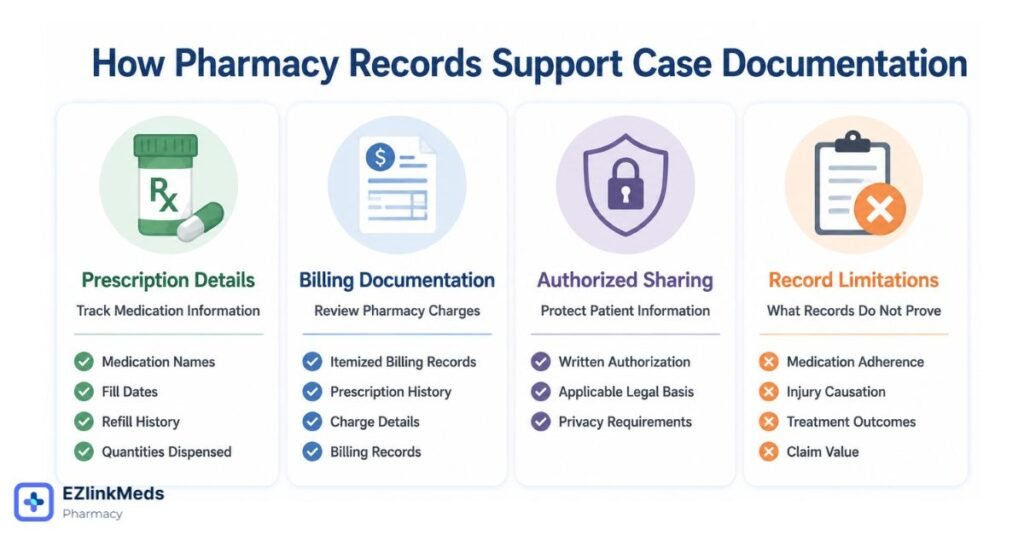
Pharmacy records help organize prescription-related information throughout a patient’s course of care. While these records may assist patients, healthcare providers, and authorized representatives in reviewing prescription history and pharmacy charges, they should not be viewed as evidence of medical outcomes or legal conclusions.
– Pharmacy records may include medication names, fill dates, refill history, quantities dispensed, and itemized billing records, helping patients review their prescription history and pharmacy-related charges.
– They may be shared only when appropriate. Prescription or billing information may be shared with the patient’s written authorization or another applicable legal basis, in accordance with privacy laws and pharmacy requirements.
– Records support organization. As part of broader med-legal prescription delivery for attorneys and doctors, they can help organize prescription information and pharmacy documentation.
– Pharmacy records have important limitations. They document prescription-related activity but do not prove medication adherence, injury causation, damages, treatment outcomes, or the value of a personal injury claim.
Important Patient Questions About Case-Settlement Payments
Before agreeing to a pharmacy billing arrangement, ask questions so you understand how prescription charges may be handled and what your responsibilities may be.
- Will I owe the pharmacy if my case does not settle? Confirm whether you remain responsible for the balance if your claim does not resolve as expected.
- Can the balance change over time? Ask whether additional prescriptions or refills may affect the total charges.
- Will I receive itemized statements? Find out whether you can request a statement showing prescriptions dispensed and related charges.
- Can my attorney receive pharmacy records? Ask what authorization is needed before prescription or billing records are shared.
- Can I dispute a charge? If you have questions about a charge, ask how the pharmacy reviews billing concerns.
- Are delivery fees included? Confirm whether any delivery fees or conditions apply if delivery is available.
- What happens if I change attorneys? Ask whether any billing information or authorizations need to be updated.
Prescription Delivery and Local Support Across Southern California
Accessing a pharmacy after an accident is not always easy, particularly for patients who are managing medical appointments or recovering at home.
EZlinkMeds may be able to assist eligible patients and referral partners in Los Angeles, Glendale, Burbank, Pasadena, Long Beach, Santa Clarita, Thousand Oaks, Westlake Village, Oxnard, Ventura, and nearby areas, subject to service availability and pharmacy requirements.
For eligible prescriptions, same-day or next-day delivery may be available within eligible delivery areas, subject to prescription verification, medication availability, order timing, delivery conditions, and applicable pharmacy requirements. Because delivery availability may vary, patients are encouraged to contact the pharmacy to confirm whether delivery is available for their prescription and location.
EZlinkMeds can also discuss available pharmacy services, prescription coordination, and delivery options based on each patient’s individual circumstances. Exact delivery coverage and service availability should be confirmed with the pharmacy before relying on a specific delivery timeframe or location.
How EZlinkMeds May Support Injured Patients and Referral Partners
Recovering after an injury often requires coordination between multiple healthcare providers and pharmacies. EZlinkMeds helps simplify the prescription process by providing a point of contact for prescription transfers, refill questions, available billing options, pharmacist support, and delivery availability.
When appropriate, the pharmacy may communicate with authorized healthcare providers or referral partners to help coordinate prescription-related information.
Patients can also speak with a pharmacist about medication-related questions and available pharmacy services. If delivery is requested, EZlinkMeds can advise whether it is available for the prescription and location, based on current pharmacy requirements and operational availability.
Conclusion
Recovering from an injury often involves more than medical appointments alone. Questions about prescription billing, payment timing, and pharmacy services are common, and reviewing your options before filling a prescription can help you make informed decisions based on your individual circumstances.
Reach out to EZlinkMeds Pharmacy to discuss prescription transfers, available billing options, pharmacist support, and delivery availability for eligible prescriptions.