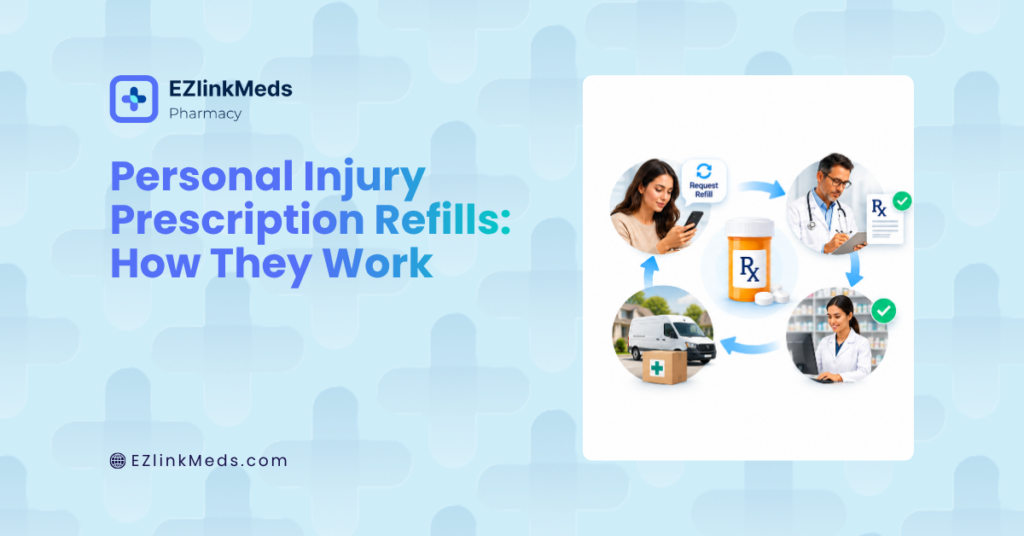



A personal injury claim does not automatically make someone eligible for a pharmacy lien arrangement. Eligibility can depend on the pharmacy’s acceptance policies, the prescription itself, required case information, and the terms of any written agreement.
The phrase “pharmacy lien” is commonly used for a contractual lien or deferred-payment arrangement connected to a personal injury case. It does not mean every arrangement is created automatically by law, nor does it mean the medication is free or guaranteed to be paid from a settlement.
For a pharmacy lien or deferred-payment arrangement, eligibility generally involves more than the fact that an injury occurred. The pharmacy must accept the case under its current policies, the prescription must meet applicable dispensing requirements, and any information or documentation required for the arrangement must be completed.
Key takeaway
- A personal injury claim does not automatically qualify a patient for a pharmacy lien or deferred-payment arrangement.
- Eligibility may depend on the pharmacy accepting the case, a valid prescription that can be lawfully dispensed, and any case information or signed documentation required under the pharmacy’s current policy.
- Attorney or case-manager involvement may be part of a pharmacy’s workflow, but it is not a universal California requirement for every pharmacy lien arrangement.
- Payment responsibility depends on the terms of the signed agreement. Deferred payment does not mean the medication is free or that payment is guaranteed from a future settlement.
What Does a “Pharmacy Lien” Mean in a California Personal Injury Case?
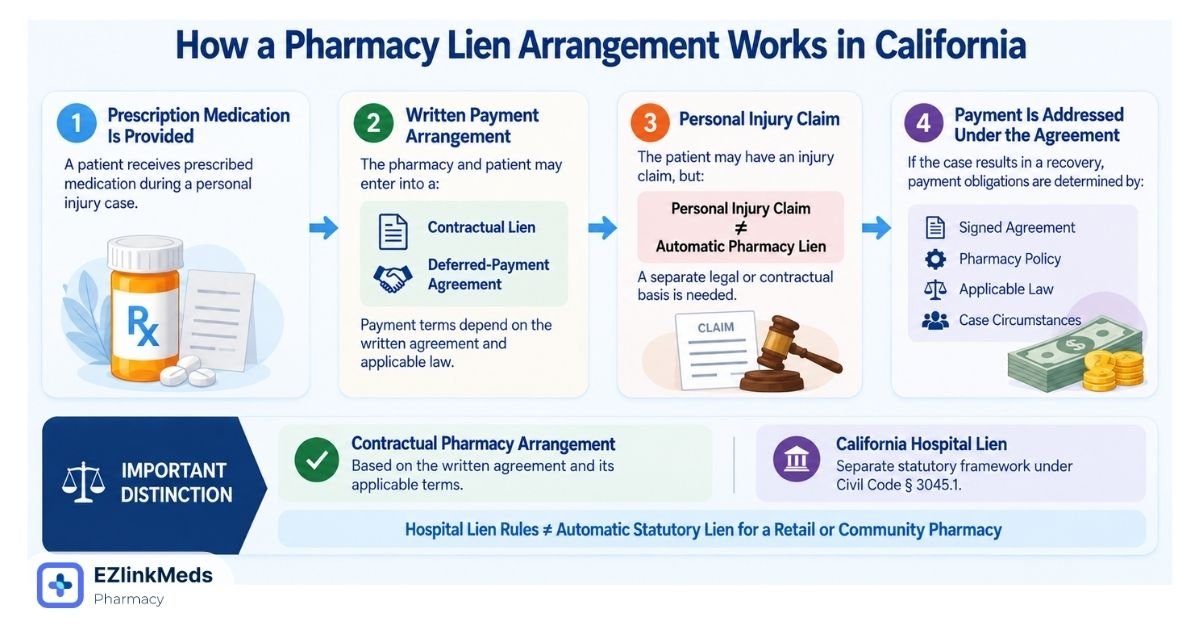
In a personal injury case, “pharmacy lien” is often used as shorthand for a contractual lien or deferred-payment arrangement involving prescription charges. The exact rights and payment obligations depend on the written agreement and applicable law. A personal injury claim alone does not automatically create a pharmacy lien.
California Civil Code § 2881 recognizes liens created by contract or by operation of law. That distinction is important because California has a separate statutory framework for hospital liens. Civil Code § 3045.1 applies to hospitals that meet the statute’s requirements and should not be treated as creating an automatic statutory lien for a retail or community pharmacy.
For this article, a pharmacy lien refers to a contractual lien or deferred-payment arrangement unless another legal basis has been specifically established. It should not be treated as:
- an automatic right after an accident,
- the same as a statutory hospital lien,
- a guarantee that the patient owes nothing,
- or a guarantee that charges will be paid from settlement proceeds.
Those details depend on the signed agreement, pharmacy policy, and the circumstances of the case.
Who may be eligible for a personal injury pharmacy lien?
A personal injury patient may be considered for a pharmacy lien or deferred-payment arrangement when the pharmacy accepts the case, the patient has a valid prescription that can be lawfully dispensed, and any required case information and written agreements are completed. Eligibility is not automatic and ultimately depends on the pharmacy’s current acceptance policies and the signed arrangement.
The clearest way to think about pharmacy lien eligibility is as a series of separate gates rather than a single qualification test.
Personal Injury Pharmacy Lien Eligibility Gates |
|
|---|---|
| Eligibility Gate | What May Need to Be Verified |
| Claim Context | The patient has an active personal injury matter or another claim type accepted under the pharmacy’s current policy, along with sufficient incident and case-contact information. |
| Pharmacy Acceptance | The pharmacy determines that the case fits its current criteria for contractual lien or deferred-payment arrangements. |
| Valid Prescription | A valid prescription has been issued by an authorized prescriber and remains subject to applicable law, pharmacist review, and the pharmacy’s dispensing requirements. |
| Connection to Injury Care | When required by pharmacy policy, the prescribed medication is being used as part of care associated with the injury claim. The pharmacy’s administrative review does not determine legal or medical causation. |
| Case Coordination | Attorney, case manager, or other authorized case-contact information may need to be provided when required by the pharmacy’s workflow. Attorney representation should not be treated as a universal California eligibility requirement. |
| Signed Documentation | The patient and any other required parties complete the pharmacy’s applicable agreement, acknowledgments, or authorizations before deferred-payment terms are used. |
| Medication and Service Feasibility | The medication must be available, appropriate for lawful dispensing, and within the pharmacy’s operational capabilities and applicable service area. |
Financial eligibility does not override pharmacy law or pharmacist judgment. A prescription must still meet legal and clinical requirements, and controlled substances are subject to additional dispensing rules.
Even when a personal injury case fits a deferred-payment workflow, not every prescription can necessarily be filled. Eligibility also depends on the pharmacy’s current policies, the prescription, the case type, and the information needed to review the arrangement.
If the case passes the initial eligibility review, the next step is confirming the paperwork required for the arrangement. See What Documents Are Needed to Set Up a Prescription Lien? for the detailed document and authorization requirements rather than treating the eligibility factors above as a complete paperwork checklist.
Does the patient need a personal injury attorney?
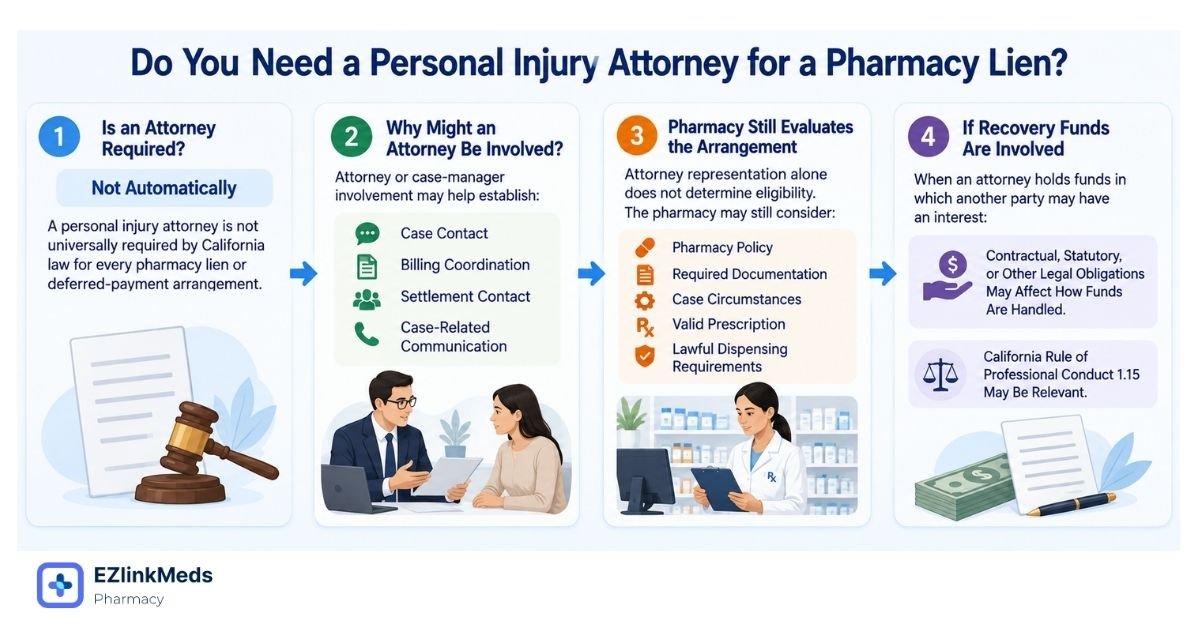
A personal injury attorney is not automatically required by California law for every pharmacy lien or deferred-payment arrangement. However, attorney or case-manager involvement may be part of a pharmacy’s workflow when the arrangement requires documented case coordination or communication about a potential recovery.
Attorney involvement may be relevant because it can help identify:
- The Case Contact: A pharmacy may need the attorney, case manager, or other authorized contact responsible for coordinating information related to the personal injury claim.
- The Billing Arrangement: The pharmacy may need to confirm how the deferred-payment agreement is documented and who should receive billing or case-related communications.
- The Settlement Contact: If payment is expected to be addressed after a recovery, the pharmacy may need a documented point of contact for settlement-related coordination.
- Third-Party Payment Issues: If an attorney later holds funds in which another person or entity may have an interest, California Rule of Professional Conduct 1.15 may affect how those funds are handled, depending on the specific contractual, statutory, or other legal obligation involved.
Attorney representation alone does not make a patient eligible for a pharmacy lien arrangement. The pharmacy still needs to evaluate the case under its own policies, and the prescription must remain valid and appropriate for lawful dispensing.
For patients, the practical point is simple: an attorney may be part of the pharmacy’s coordination process, but attorney involvement is not a universal legal requirement or a guarantee that the case will be accepted. When multiple professionals are involved, coordination between attorneys, case managers, providers, and the pharmacy can help organize prescription-related communication throughout the case.
Does the prescription have to be related to the injury?
For a pharmacy lien or deferred-payment arrangement connected to a personal injury case, the pharmacy may need information showing that the prescription is being used as part of the patient’s injury-related care. The exact screening requirements depend on the pharmacy’s policies and the terms of the arrangement.
That administrative connection should not be confused with a determination of legal or medical causation. A pharmacy does not decide whether an accident legally caused a particular condition simply by reviewing a prescription for a lien-based workflow.
Instead, the pharmacy may review the prescription and available case information to determine whether the request fits its accepted personal injury process.
A valid prescription is still required
Eligibility for a deferred-payment arrangement does not override ordinary prescription requirements. California pharmacy rules require pharmacists to exercise professional judgment when performing pharmacy functions, including reviewing prescription and patient information and consulting when appropriate.
Additional requirements apply to controlled substances. California law places responsibility on both the prescriber and dispensing pharmacist concerning prescriptions for controlled substances issued for a legitimate medical purpose in the usual course of professional practice.
In practical terms, two separate questions may need to be answered:
– Does the prescription fit the personal injury case workflow? The pharmacy may consider available case information and its acceptance policies.
– Can the prescription lawfully and appropriately be dispensed? The pharmacist must apply the legal and professional requirements applicable to dispensing.
Meeting the first condition does not guarantee the second. Likewise, having a valid prescription does not by itself mean that a patient qualifies for a pharmacy lien or deferred-payment arrangement.
What can prevent a pharmacy from accepting a lien case?
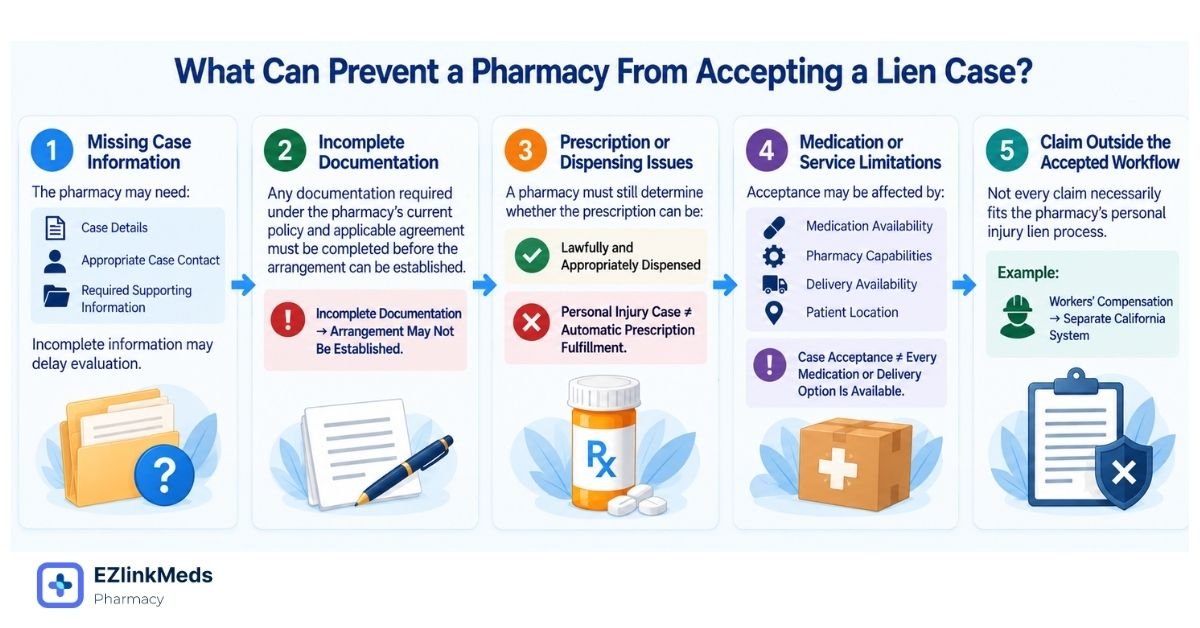
A personal injury claim and a valid prescription do not guarantee that a pharmacy will accept a lien or deferred-payment arrangement.
Acceptance can depend on the pharmacy’s current policies, the information available about the case, completion of the required agreement, and the pharmacy’s ability to lawfully fill the prescription.
Common issues that may prevent or delay acceptance include:
Missing Case Information: The pharmacy may need sufficient information about the personal injury matter and an appropriate case contact to evaluate the requested arrangement.
Incomplete Agreements or Authorizations: Required contractual documents, acknowledgments, or authorizations may need to be completed before deferred-payment terms can be established.
Prescription Issues: A prescription that cannot lawfully or appropriately be dispensed cannot be filled simply because it is connected to a personal injury claim. Pharmacists remain responsible for complying with applicable dispensing requirements and exercising professional judgment.
Medication Availability or Pharmacy Capabilities: A pharmacy may be unable to fulfill a particular prescription because of medication availability or other operational limitations. Acceptance of the case does not mean every prescribed medication will necessarily be available.
Service or Delivery Limitations: When delivery is requested, availability may depend on the pharmacy’s current delivery capabilities and the patient’s location. Eligibility for a billing arrangement does not by itself guarantee a particular delivery option or timeframe.
Claim Outside the Pharmacy’s Accepted Workflow: Not every type of claim necessarily falls within a pharmacy’s personal injury lien process. Workers’ compensation claims, for example, are governed by a separate California system and should not automatically be treated as personal injury lien cases.
No single factor automatically determines pharmacy lien eligibility. The pharmacy must evaluate the requested arrangement while continuing to follow the legal and professional requirements that apply to prescription dispensing.
What happens after the pharmacy accepts the case?
Once a pharmacy accepts a personal injury case for a lien or deferred-payment arrangement, the next steps generally involve confirming the required paperwork, completing the pharmacy’s dispensing review, and arranging medication fulfillment when the prescription can be lawfully filled.
The process may include:
- Confirming the Arrangement: The pharmacy verifies that the required agreement, acknowledgments, and case information have been completed before deferred-payment terms are used.
- Reviewing the Prescription: The pharmacist evaluates the prescription under the same legal and professional standards that apply to other prescriptions. Acceptance of the billing arrangement does not guarantee that a prescription will be dispensed.
- Communicating When Clarification Is Needed: If a prescription requires clarification, the pharmacist may communicate with the licensed prescriber or other authorized healthcare professionals as permitted by law.
- Filling the Medication: When the prescription can be lawfully and appropriately dispensed, the pharmacy prepares the medication for pickup or available delivery.
- Maintaining Prescription and Arrangement Records: Required pharmacy records are maintained under applicable pharmacy recordkeeping requirements, while documentation related to the deferred-payment arrangement is maintained according to the agreement and other applicable requirements.
The exact paperwork needed to establish the arrangement can vary.
What If the Personal Injury Case Does Not Settle?
If a personal injury case does not result in a settlement or other recovery, responsibility for unpaid prescription charges depends on the signed agreement and applicable law. A lien or deferred-payment arrangement should not be interpreted as a guarantee that the patient will never owe the balance.
Because the consequences depend on the particular agreement, patients should review What Happens to a Pharmacy Lien If a Personal Injury Case Does Not Settle? for a fuller explanation of payment responsibility when a claim ends without a recovery.
What should a patient confirm before signing a pharmacy lien agreement?
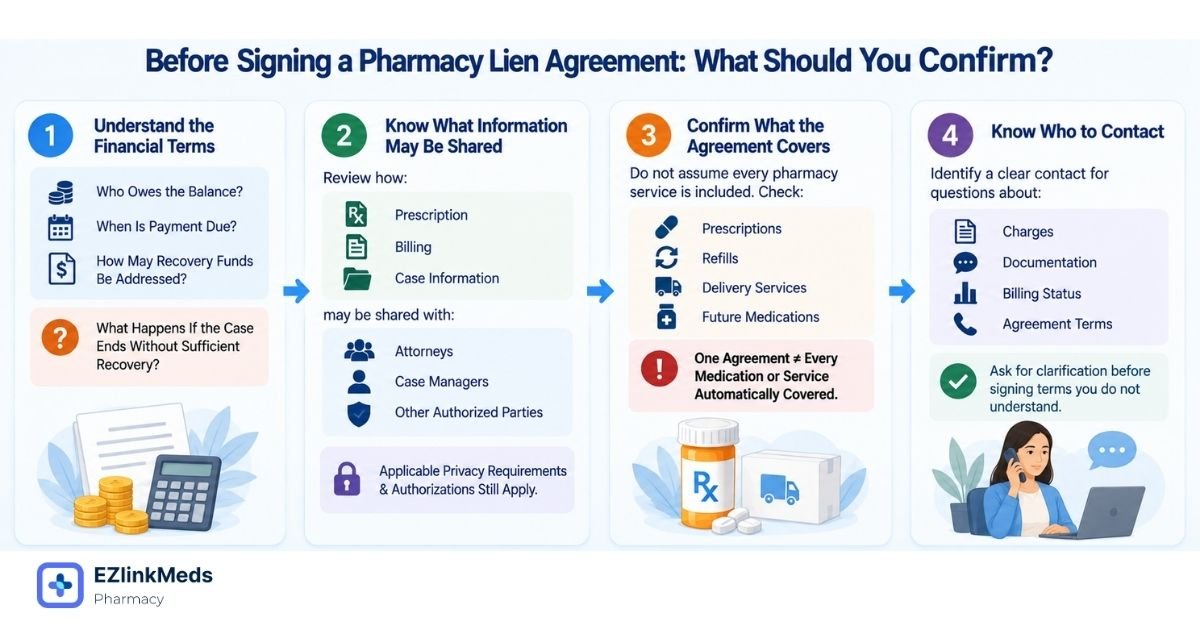
Before signing a pharmacy lien or deferred-payment agreement, patients should understand how the arrangement works, what information may be shared, and what financial responsibilities may remain.
The agreement should be reviewed as a contract, not as a promise of free medication or guaranteed payment from a future settlement.
Confirm the Financial Terms
Patients should review:
Who Is Responsible for the Balance: The agreement should identify who may ultimately be responsible for unpaid prescription charges.
When Payment Becomes Due: Patients should understand the events that may trigger payment, including settlement, case resolution, or other circumstances described in the agreement.
How Settlement Funds May Be Handled: If the arrangement anticipates payment from a personal injury recovery, the agreement should explain how the pharmacy’s charges may be addressed and which parties are involved in that process.
What Happens If the Case Does Not Produce a Recovery: Patients should review any provisions describing responsibility for the balance if the claim is dismissed, denied, or otherwise ends without sufficient recovery.
Confirm What Information and Services Are Covered
Patients should also understand the scope of the arrangement itself.
What Information May Be Shared: Prescription, billing, and case information may involve protected health information. Any disclosure to attorneys, case managers, or other third parties should comply with applicable privacy requirements and any necessary authorization.
What Services the Agreement Covers: Patients should confirm which prescriptions, refills, delivery services, or other pharmacy services are included rather than assuming every medication or future prescription will fall under the same arrangement.
Know Who to Contact With Questions
The agreement should provide a clear point of contact for questions about prescription charges, documentation, billing status, or the terms of the arrangement. Patients should ask for clarification before signing any provision they do not understand.
A pharmacy lien or deferred-payment arrangement can affect both prescription access and financial responsibility, so the terms should be clear before medications are dispensed under that arrangement.
Once these points are understood, patients can request an eligibility review with EZlinkMeds to find out whether their prescription case can be considered under the pharmacy’s current personal injury workflow.
Conclusion
Qualifying for a pharmacy lien or deferred-payment arrangement after a personal injury is not automatic. Eligibility depends on factors such as the pharmacy’s acceptance policies, the prescription, required case information, lawful dispensing requirements, and the terms of the written agreement.
Before entering an arrangement, patients should understand how prescription charges will be handled, who may remain responsible for payment, and what happens if the personal injury case does not result in a recovery. Attorney involvement or an active injury claim alone does not guarantee acceptance.
Patients, attorneys, case managers, and prescribing providers can connect with EZlinkMeds to request an eligibility review and determine whether a prescription case can be considered under the pharmacy’s current personal injury workflow.