


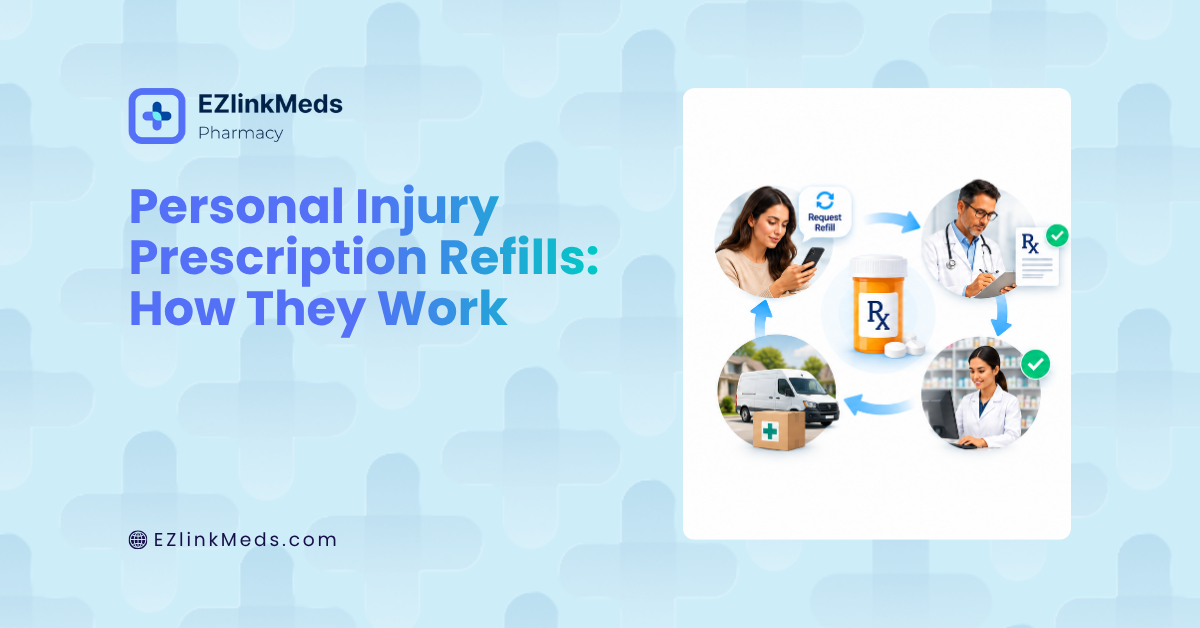
Prescription refills during an active personal injury case depend on the prescription and medication, not simply on whether the injury claim remains open. The prescription must still authorize another dispensing, or the prescriber must provide new authorization when required.
Each refill involves two separate checks. The Medication Authority determines whether another dispensing is legally authorized. Case Administration addresses the billing, lien, case information, and any requested delivery arrangements.
An active claim, attorney involvement, or deferred-payment arrangement does not create refill authorization or extend a prescription. Requesting a refill before the current supply is exhausted gives the pharmacy time to identify whether additional prescriber or case information is needed.
Key takeaway
- An active personal injury case does not automatically authorize prescription refills. The prescription must have valid refill authorization, or the prescriber must provide new authorization when required.
- Schedule II controlled-substance prescriptions cannot be refilled. Another lawful dispensing generally requires a new prescription or another legally permitted pathway, which is not the same as a refill.
- Schedule III and IV controlled-substance prescriptions have strict refill limits. Federal law generally allows no more than five refills within six months after the prescription is issued, while applicable California requirements must also be satisfied.
- Prescription authority and personal injury case billing are separate. A lien or deferred-payment arrangement may affect how an authorized refill is billed, but it does not authorize the refill itself. Both prescription and case-administration requirements may need to be current before dispensing under a case-related payment arrangement
Can You Refill Accident-Related Medication While a Personal Injury Case Is Still Active?
Yes, when the prescription legally supports another dispensing or the prescriber provides the authorization required for it. An open personal injury case by itself does not authorize an accident prescription refill.
California law generally requires prescriber authorization before a prescription for a dangerous drug or device can be refilled. That authorization may already exist as refills on the prescription. When no authorized refills remain, additional prescriber authorization may be necessary before the pharmacy can dispense more medication.
The personal injury case creates a separate administrative track. A pharmacy may also need to confirm the status of a lien or deferred-payment arrangement, case information, or other billing requirements. But an attorney, case manager, or active lien arrangement cannot replace the medication authorization required from the prescriber.
In practice, this means a case can remain active even though a particular prescription has reached the end of its authorized refills. The pharmacy must evaluate the prescription itself before determining the appropriate next step. For the broader process from the original prescription through pharmacy dispensing, see how accident prescriptions are filled: from prescriber to pharmacy to patient.
What does the pharmacy check before refilling the prescription?
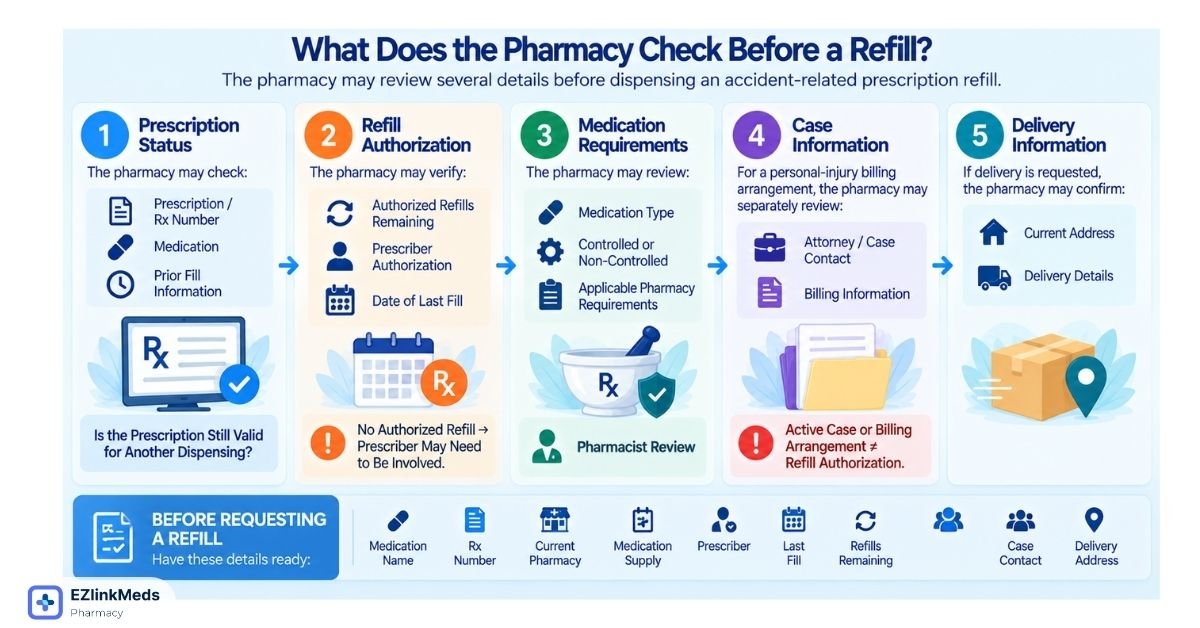
Before dispensing an accident prescription refill, the pharmacy needs to confirm that the prescription still supports another dispensing.
The review can include the prescription itself, remaining authorized refills, prior dispensing information, prescriber authorization, and whether the medication is subject to controlled-substance restrictions.
The pharmacist must also complete the professional and legal review required for the medication. For patients using a personal injury billing arrangement, case-related information may need to be reviewed separately. A current case or billing arrangement does not replace the prescription requirements.
Before You Request an Accident-Medication Refill
Having the following information ready can reduce avoidable back-and-forth:
- Medication name
- Prescription or Rx number, if available
- Current pharmacy
- Remaining doses or approximate medication supply
- Prescriber name and contact information
- Date of the last fill, if known
- Number of authorized refills remaining, if known
- Whether the medication is controlled, if known
- Attorney or other applicable case contact
- Current delivery address, if delivery is requested
The pharmacy can then determine whether an authorized refill remains, whether additional prescriber involvement is required, and whether any case-related billing or delivery information also needs to be updated.
Having the information ready does not guarantee that a refill can be dispensed. Refill eligibility ultimately depends on the prescription, the medication involved, applicable pharmacy requirements, and the pharmacist’s review.
Prescription Refill Scenarios During an Active Personal Injury Case |
||
|---|---|---|
| Refill Scenario | Medication Authority | Personal-Injury Case Administration |
| Non-Controlled Prescription With Refills Remaining | The pharmacy verifies valid refill authorization and dispensing requirements. | Case-related billing eligibility is checked separately. |
| No Authorized Refills Remaining | New prescriber authorization is generally required, subject to limited lawful exceptions. | An attorney or case manager cannot authorize a medication refill. |
| Schedule II Controlled Substance | Refills are prohibited. Additional dispensing generally requires a new prescription or another legally permitted pathway. | An active claim or lien does not create refill authority. |
| Schedule III–IV Controlled Substance | Federal five-refill/six-month limits and applicable California restrictions apply. | The pharmacy separately verifies any relevant billing arrangement. |
| Prescriber Unavailable | California’s limited emergency-refill provision may apply, subject to statutory conditions and pharmacist judgment. | Case status does not establish eligibility for an emergency refill. |
How do normal non-controlled prescription refills work?
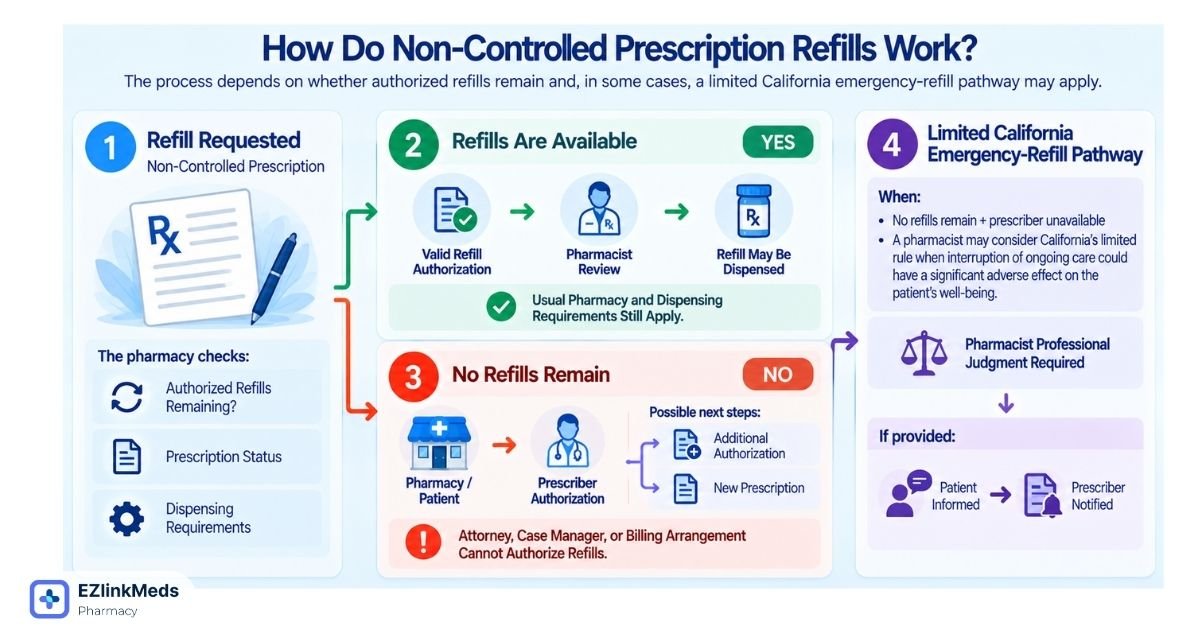
For a non-controlled medication, the pharmacy first checks whether the prescription has authorized refills remaining and whether it can still support another dispensing. When valid refill authorization remains, the pharmacy can process the refill subject to the usual pharmacist review and applicable dispensing requirements.
When There Are No Authorized Refills Left
When the prescription has no authorized refills remaining, the pharmacy generally needs additional authorization from the prescriber before dispensing another refill. Depending on the circumstances, the pharmacy may contact the prescriber for authorization, or the prescriber may need to issue a new prescription.
An active personal injury case does not change this requirement. An attorney, case manager, or lien arrangement cannot add refills to a prescription or authorize medication in place of the prescriber.
California’s Limited Emergency-Refill Rule
California law also provides a limited pathway when a prescription has no remaining refills and the prescriber is unavailable. Under Business and Professions Code § 4064, a pharmacist may refill a prescription for a dangerous drug or device without prescriber authorization when, in the pharmacist’s professional judgment, failure to provide the medication would interrupt ongoing care and have a significant adverse effect on the patient’s well-being.
This is not a guaranteed emergency refill. The pharmacist must determine, using professional judgment, that the conditions in California law are satisfied. When a refill is provided under this provision, the pharmacist must inform the patient and notify the prescriber within a reasonable period of time.
Personal injury case status does not determine whether this limited provision applies.
What Changes if the Accident Medication Is a Controlled Substance?
Controlled-substance prescriptions have additional refill restrictions. The pharmacy must identify the medication’s schedule, confirm whether another dispensing is legally permitted, and complete the required pharmacist review. An active personal injury case does not change these rules.
Schedule II prescriptions cannot be refilled
A Schedule II prescription cannot be refilled under federal or California law. If additional medication is prescribed after the authorized dispensing has been completed, a new prescription or another legally permitted dispensing pathway may be required.
A new prescription is not the same as a refill. Likewise, the existence of an active injury case, attorney representation, or pharmacy billing arrangement does not create a right to additional Schedule II medication.
Schedule III and IV prescriptions have refill limits
Schedule III and IV prescriptions may have authorized refills, but they are subject to strict limits. Under federal law, these prescriptions generally cannot be refilled more than five times within six months after the prescription is issued.
California imposes an additional limit. For Schedule III and IV prescriptions, all refills taken together may not exceed a 120-day supply.
These limits establish the maximum permitted refill framework. They do not guarantee that every authorized refill will be dispensed. The pharmacist must still determine that dispensing complies with applicable controlled-substance requirements and professional responsibilities.
Personal injury billing remains a separate issue. Even when another controlled-substance dispensing is legally permitted, the pharmacy may separately need to verify the patient’s case-related payment or billing arrangement.
What Happens When the Prescription Has No Refills Left?
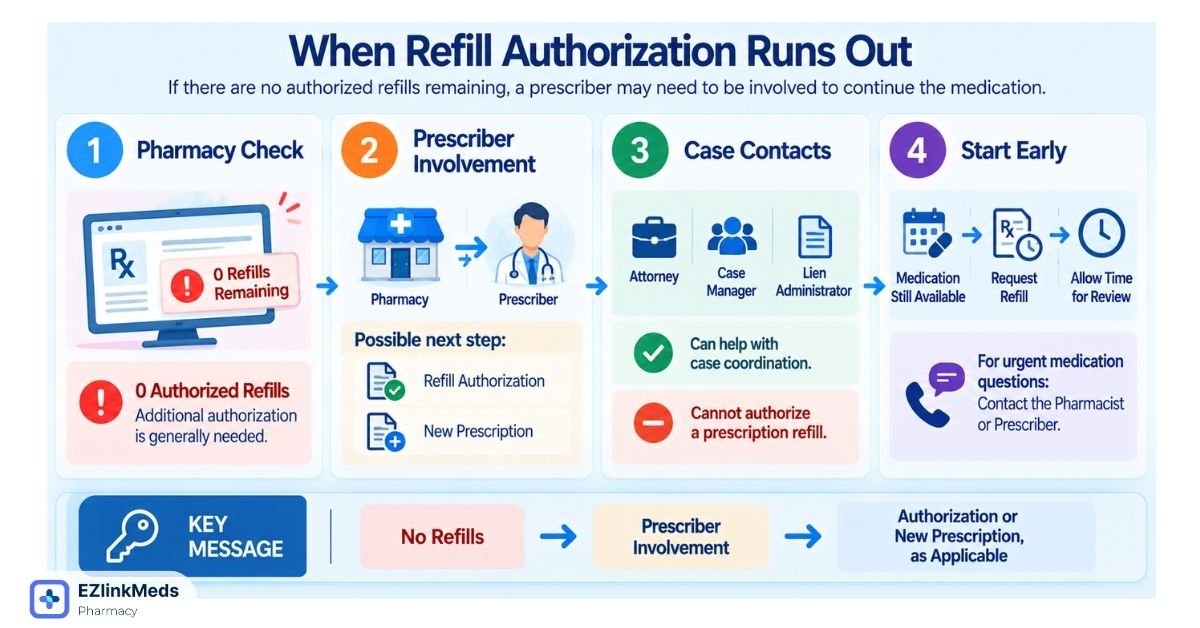
When no authorized refills remain, additional prescriber involvement is generally required before another dispensing can occur. The pharmacy may contact the prescriber for authorization, or the prescriber may need to issue a new prescription, depending on the medication and applicable requirements.
An attorney, case manager, or lien administrator can assist with case coordination but cannot authorize a refill in place of the prescriber. An active personal injury case does not extend a prescription or add refills.
Requesting a refill before the current supply is exhausted gives the pharmacy time to identify whether new authorization is needed. For urgent medication concerns while authorization is pending, patients should contact their pharmacist or prescriber rather than changing how they take the medication on their own.
Does the pharmacy lien or case status affect whether the refill can be filled?
A personal injury lien or deferred-payment arrangement may affect how an authorized refill is billed, but it does not determine whether the prescription itself can be refilled.
These are two separate checks:
Medication authority: The pharmacy determines whether valid refill authorization exists and whether another dispensing is permitted under applicable pharmacy requirements.
Case administration: The pharmacy separately determines whether the refill can be handled under the applicable personal injury billing arrangement.
For the case-administration side, the pharmacy may need current attorney or case contact information, updated case details, or other documentation required under its billing process. An existing arrangement should not be assumed to cover every future prescription or refill automatically.
Likewise, an active case, attorney representation, or existing lien cannot extend an expired prescription, add authorized refills, or replace authorization that must come from the prescriber.
Patients who need more information about the financial side can refer to how prescription liens work after an accident in california and what documents are needed to set up a prescription lien? The refill process remains focused on whether another dispensing is authorized and what steps are needed to keep medication and case administration coordinated.
How to Avoid Preventable Refill Delays During an Active Injury Case
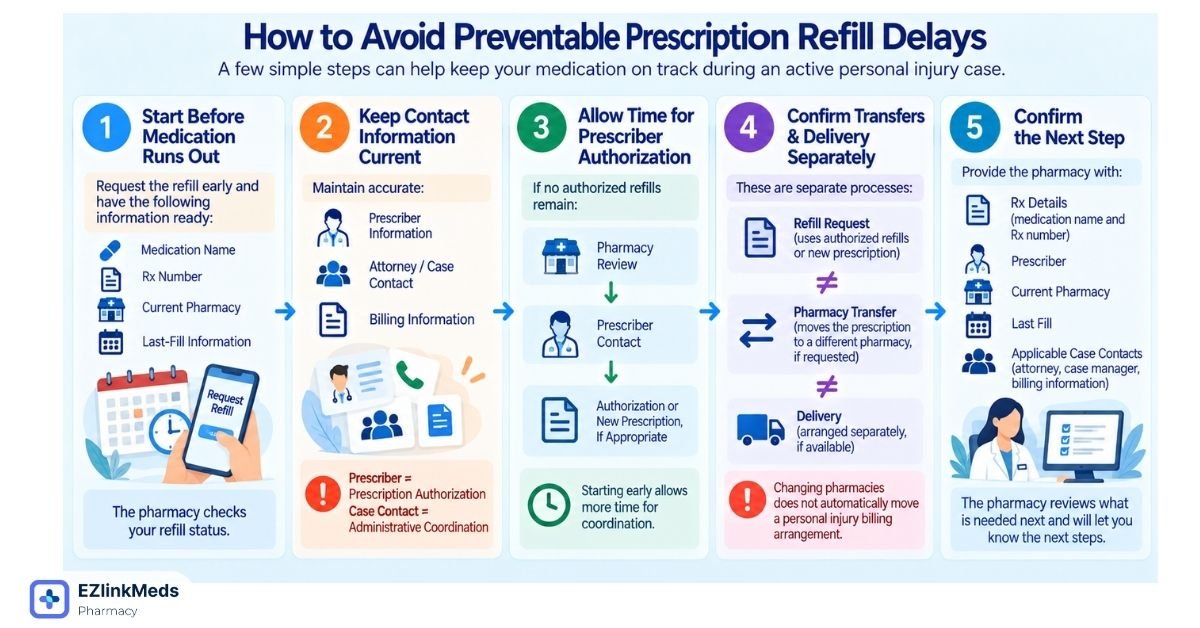
Starting the refill process before the current medication supply is exhausted gives the pharmacy more time to identify whether prescriber authorization, updated case information, or another step is needed.
Start the Refill Request Early
Contact the pharmacy before the medication supply runs out. Provide the medication name, Rx number if available, current pharmacy, and last-fill information so the pharmacy can check the prescription and determine whether authorized refills remain.
Keep Prescriber and Case Information Current
Accurate prescriber information is important if the pharmacy needs additional refill authorization or a new prescription. If the medication is being handled through a personal injury billing arrangement, keep the attorney or other applicable case contact information current as well.
Remember that these are separate processes. Case contacts can assist with administrative coordination, but they cannot provide prescription authorization in place of the prescriber.
Allow Time for Prescriber Authorization When Needed
When no authorized refills remain, additional prescriber involvement may be required. The pharmacy may contact the prescriber for authorization, or the prescriber may need to issue a new prescription depending on the medication and circumstances.
Starting early provides more time for this coordination without assuming that additional dispensing will be authorized.
Confirm Pharmacy Transfers and Delivery Separately
Patients who are changing pharmacies should follow the separate process explained in how to transfer an accident-related prescription to a new pharmacy. A refill request does not automatically transfer a prescription or move an existing personal injury billing arrangement to another pharmacy.
Delivery should also be confirmed separately. An authorized refill does not automatically establish delivery availability or timing.
Start a Refill-Status Review With EZlinkMeds
Patients or authorized case contacts can provide EZlinkMeds with the medication or Rx details, prescriber information, current pharmacy, last-fill information, and applicable case or billing contacts to begin a refill-status review.
The pharmacy can then determine the next appropriate step for the prescription and identify whether additional prescriber or case information is required. Refill authorization, dispensing, delivery, and acceptance under a personal injury billing arrangement remain subject to pharmacy review.
Conclusion
An active personal injury case does not automatically keep a prescription refillable. Each refill still depends on valid prescription authority, the type of medication, and applicable pharmacy requirements. Case billing, lien arrangements, and delivery coordination remain separate parts of the process.
Starting the refill request before the current medication supply is exhausted gives the pharmacy time to check remaining refills, identify whether prescriber authorization is needed, and review any case-related requirements.
Patients or authorized case contacts can provide EZlinkMeds with the prescription, prescriber, pharmacy, and applicable case information to begin a refill-status review and determine the next appropriate step.